Your Brain's Hidden Clues May Reveal Future Memory Loss
Imagine knowing years ahead if your memory might fade, allowing you to prepare or even intervene. New AI tools are now quietly sifting through your medical records to find these subtle, early warnings.

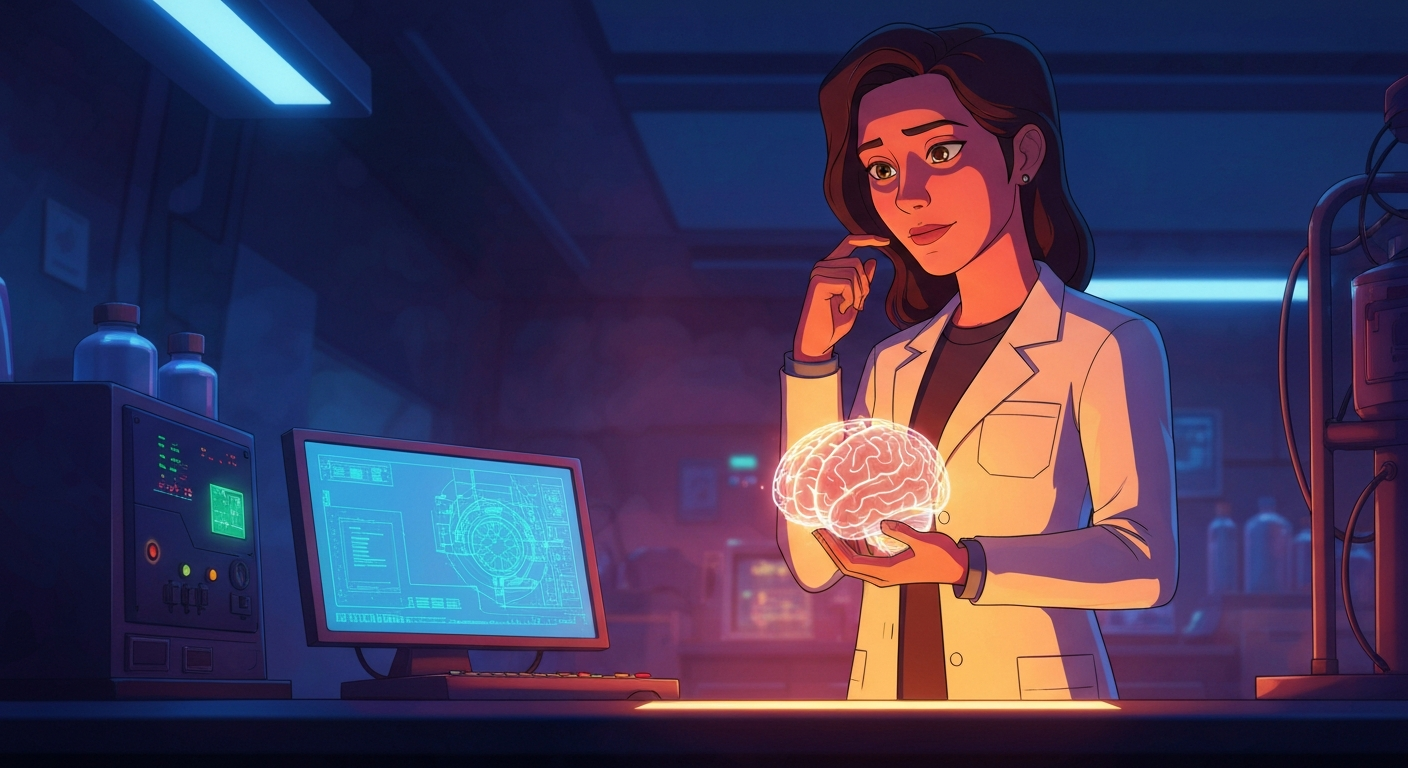
What if you could peer into a crystal ball and see the health of your brain years down the line? It’s not a sci-fi fantasy anymore. Instead of a magical orb, researchers are using incredibly smart computer programs—what we call Artificial Intelligence (AI)—to sift through mountains of medical data and spot the whisper of memory loss before it becomes a shout. This new approach might give us a chance to intervene earlier than ever before.
This isn't science fiction, but rather the cutting edge of real, peer-reviewed science. Scientists at the University of California, San Francisco (UCSF) and other collaborating institutions like the National Alzheimer's Coordinating Center (NACC) are leading this charge. They’re using complex AI models to analyze detailed clinical features – everything from your medical history and cognitive test results to genetics and even lifestyle factors. This work, published in a pre-print in May 2024, showcases an exciting new direction in predicting conditions like dementia before they dramatically impact your life.
How AI Gathers Clues About Your Brain's Future
The core idea here involves what's called "pathology-aware representation learning." Think of it like a master detective (the AI) who doesn't just look at obvious clues, but also understands the specific patterns that link various pieces of evidence together. Instead of just seeing a few scattered footprints, the AI is trained to recognize the specific "gait" of a person, even if only partial prints are visible.
This AI uses a technique called TabPFN embedding. Imagine you have a giant spreadsheet of patient information, full of different types of data—numbers, categories, missing entries. TabPFN is like a brilliant librarian who can read this messy data and turn it into a compact, meaningful "summary" for each patient. It essentially learns to capture the essence of a patient's clinical profile, even with imperfect information.
From these summaries, the AI then builds what are called "latent variables" for pathology, scaled from 0 to 1. Think of these as five hidden dials inside your brain, each representing a different kind of brain change associated with memory loss, like amyloid plaques or tau tangles – specific proteins that build up in the brain, much like rust on a car engine. A "0" on a dial means no pathology, and a "1" means the maximum observed pathology. The AI deduces the settings of these hidden dials even when direct measurements are scarce.

The Synthetic Patients Helping Us Understand Real Brains
Perhaps the most surprising part of this research is the use of "synthetic patients." The AI employs a method called Denoising Diffusion Probabilistic Models (DDPMs). This is like an artist who learns to draw realistic faces by starting with random static and gradually "denoising" it until a clear picture emerges. Here, the AI generates entirely new, fake patient profiles, complete with clinical features and those five "pathology dial" settings.
Why do this? Well, real patient data can be limited, especially for rare disease progression stages. By creating synthetic patients – essentially high-fidelity simulations – the AI can explore how different combinations of clinical features and pathology dials interact. It's like having an infinite number of training scenarios to learn from, allowing the AI to become incredibly adept at predicting complex outcomes. This approach could even help train other AI systems to identify subtle issues that your doctor's AI will see hidden sickness.
What Skeptics Still Want to See
Of course, this is powerful stuff, and skeptics rightly want robust proof. The main hurdles involve validating these AI predictions in diverse real-world populations, not just the datasets used for training. Researchers need to show that the AI's predictions hold true for people from different backgrounds, with varying health conditions, and in different stages of life.
The next step is also moving from prediction to intervention. Knowing you might have a higher risk is one thing; having effective ways to reduce that risk is another. Clinical trials will be essential to test if early warnings, coupled with lifestyle changes or emerging treatments, can actually alter the trajectory of brain health. For example, some research suggests maintaining stable your blood sugar is quietly stealing memory could be key.
The World Where We Catch It Early
Imagine a future, perhaps within the next 10-15 years, where routine check-ups include an AI analysis of your brain health trajectory. You wouldn't just get a general health report; you'd receive a personalized risk assessment for cognitive decline, long before any noticeable symptoms appear. If your brain's "dials" show an upward trend in certain pathologies, your doctor could recommend specific interventions, like dietary adjustments, targeted exercise, or even certain medications being developed today.
This early insight would empower individuals to make informed choices. It could mean optimizing your lifestyle years in advance, giving you a tangible edge against brain disease. Beyond individual care, this technology could also accelerate drug discovery, allowing researchers to identify at-risk populations for clinical trials more efficiently and test therapies designed to tackle specific brain pathologies. It’s like having a personalized early warning system for your brain’s future, shifting the focus from treating a crisis to preserving health proactively. This kind of predictive power could fundamentally change how we approach aging and long-term well-being, moving us closer to a world where we understand our bodies better than ever before.
Key Takeaways
- AI is learning to predict future memory loss years in advance by analyzing complex medical data.
- The AI creates "synthetic patients" to better understand various disease progressions, improving its predictive power.
- This technology promises early intervention strategies for cognitive decline, potentially shifting healthcare from reactive treatment to proactive prevention.
Frequently Asked Questions
What is "pathology-aware representation learning"? It's an AI technique where the computer learns to understand and represent different underlying brain changes (pathologies) linked to memory loss, even from indirect medical data. This helps it spot patterns more accurately.
How do synthetic patients help this research? Synthetic patients are AI-generated, realistic patient profiles that allow researchers to simulate many different scenarios. This expanded dataset helps the AI learn to predict disease progression more robustly, especially for rare cases.
When could this AI be used in clinics? While promising, this technology is still in the research phase. It could be 10-15 years before such AI tools are fully validated, pass regulatory approvals, and become a standard part of routine clinical practice for predicting memory loss.
Editorial note: The scientific findings presented in this article are sourced exclusively from published research papers, peer-reviewed studies, certified inventions, and registered patent filings. Images generated by AI.
Stay ahead of the curve
The science that shapes tomorrow — in your inbox every week
The scientific findings presented in our articles are sourced from published research papers, peer-reviewed studies, certified inventions, and registered patent filings. Subscribe for focused weekly coverage, hands-on explainers, and practical insights that help you stay curious — no jargon, no noise.
By subscribing, you agree to receive newsletter and marketing emails, and accept our Terms of Use and Privacy Policy. You can unsubscribe anytime.
Robotics, Autonomous Systems & Human-Machine Interaction
Robotics journalist covering the machines increasingly sharing our roads, hospitals, factories, and homes — and asking the right questions about all of it.
View full profile →