Why Your Soil Is Always Secretly Thirsty
Did you know that even after a good rain, your soil might still be struggling to hold water where plants need it most? Discover how scientists are finally mapping the hidden water pathways beneath your feet, promising healthier crops and a more stable food future.
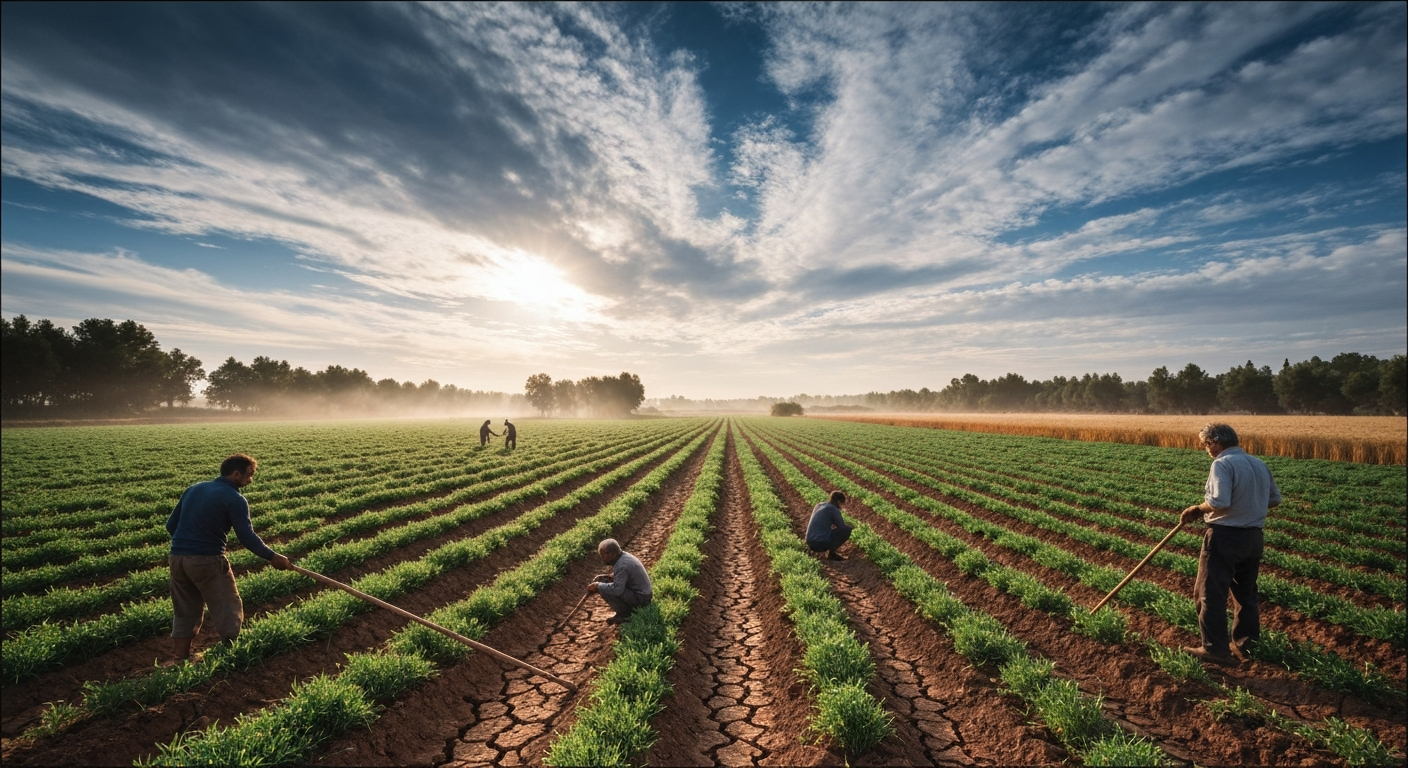
Have you ever wondered why some patches of your garden seem to dry out faster than others, even after you've watered everything evenly? It's not just about how much water you pour on; it's about what the soil does with that water. For decades, we've thought about soil like a giant, simple sponge, absorbing moisture in a predictable way. But that picture is far too simplistic, and it's holding back how well we grow our food.
The real challenge is that water doesn't just spread evenly through soil. It takes complex, often invisible, pathways. This leads to what we call the "thirsty soil paradox": you can have plenty of rain, but your crops still suffer because the water isn't reaching their roots efficiently. Current models, like the well-known Richards' equation, assume water moves slowly and predictably, almost like honey spreading on toast. But actual soil is much more like a labyrinth, with water rushing through some channels while others stay stubbornly dry.
Scientists are now mapping these hidden water mazes beneath our feet, not by digging them up, but by understanding the tiny spaces, or pores, within the soil itself. Imagine soil as a sponge made of countless tiny tunnels, big and small, all interconnected. Water moves through these tunnels, but not all at the same speed or in the same direction. This new approach, developed by researchers like Professor Charles P. Rubenstein from Columbia University, looks at the statistical physics of these water movements – essentially, the probabilities and forces governing water flow at a super-fine level.
How does it work? Think of it like a microscopic traffic report for water. Instead of just tracking the total amount of water, this new theory charts the "pore-occupancy," which is the fraction of pores of a specific size that are actually filled with water at any given spot and time. It’s like knowing not just how many cars are on the road, but also how many are in the fast lane, how many are stuck in gridlock, and how those numbers change moment by moment. This more detailed picture helps explain why some areas get plenty of water while others remain parched, even when they're right next to each other.
Mapping the Hidden Waterways Beneath Your Crops
This new understanding relies on a concept called the Damkohler number (Da), which sounds technical but is pretty intuitive. It’s a single number that tells you how quickly water moves through a pore compared to how quickly the overall system of pores reacts. If the Damkohler number is small, water moves slowly and predictably, like in the traditional models. But if it's large, water speeds through in "preferential flows," bypassing some areas completely, like a river carving its own quick path through a landscape. This is a surprising fact: the same physical rules govern both slow, even spread and fast, uneven flow; it’s just a matter of this Damkohler number.
This framework is a huge step forward because it unifies phenomena that were previously treated as separate problems. It explains how dry patches can persist in wet soil, a phenomenon known as hysteresis – imagine trying to re-inflate a deflated balloon; it takes more effort to start filling it than to keep it inflated. The new theory suggests hysteresis isn’t just a per-pore quirk, but a systemic geometric phase, like a subtle twist in the road that forces water to take a different path depending on if it's wetting or drying.
What does this mean for you, the person who grows food or simply enjoys fresh produce? Currently, farmers make critical decisions about irrigation, fertilizers, and even crop selection based on a simplified view of soil water. This often leads to wasted water, nutrient runoff, and stressed plants. By understanding the true complexity of water movement, we can develop far more precise irrigation strategies and grow food more efficiently. This isn't just about saving water; it's about boosting yields and making our agricultural systems more resilient in a changing climate.
Predicting Soil Health Without Digging
One of the most exciting parts of this new science is its potential to predict soil behavior without relying on trial-and-error field tests. Imagine being able to "see" how water will move through your soil just by analyzing its pore structure. This can be done using non-invasive techniques like micro-CT scans, which essentially create a 3D X-ray of the soil's internal architecture, showing all those tiny tunnels and connections. This data can then be fed into the new model.
This is a big shift. Instead of waiting to see how a crop reacts to watering, or constantly measuring soil moisture in the field, we could soon predict how a specific soil will behave based on its inherent physical makeup. This kind of advanced prediction could revolutionize how we manage farms, helping them adapt to different weather patterns and maximize every drop of water. While this is still a developing field, with practical applications likely 5-10 years away for widespread use, the foundational science is here. It will allow us to grow better food with less water, protecting our planet's most precious resource.
It promises to unlock secrets hidden in the ground, allowing us to manage Earth's life support systems with unprecedented insight. This isn't just a win for farmers; it's a win for all of us who rely on the soil to feed the world.
Key Takeaways
- Traditional soil water models are too simplistic, leading to inefficient watering and stressed plants.
- New statistical physics models map hidden water pathways in soil based on pore size and water flow dynamics.
- This approach, using the Damkohler number, can predict water movement and improve irrigation, making farming more sustainable.
Frequently Asked Questions
What is pore-occupancy? Pore-occupancy is a measure of how full tiny spaces (pores) of a specific size are with water at a certain location and time in the soil. It gives a detailed picture of water distribution.
How does the Damkohler number help understand soil water? The Damkohler number helps predict if water will spread slowly and evenly through soil or rush through in fast, uneven "preferential flows," which is key for efficient irrigation.
Why does understanding soil water matter for farming? Better understanding soil water helps farmers irrigate more precisely, conserve water, reduce nutrient runoff, and grow healthier crops, leading to more sustainable food production.
Editorial note: The scientific findings presented in this article are sourced exclusively from published research papers, peer-reviewed studies, certified inventions, and registered patent filings. Images generated by AI.
Stay ahead of the curve
The science that shapes tomorrow — in your inbox every week
The scientific findings presented in our articles are sourced from published research papers, peer-reviewed studies, certified inventions, and registered patent filings. Subscribe for focused weekly coverage, hands-on explainers, and practical insights that help you stay curious — no jargon, no noise.
By subscribing, you agree to receive newsletter and marketing emails, and accept our Terms of Use and Privacy Policy. You can unsubscribe anytime.
Sustainable Food Systems, Mediterranean Agriculture & Food Waste Innovation
Italian food systems journalist writing about the science of producing food more sustainably — and wasting far less of it.
View full profile →