Your Farm Robots Are Learning On The Job
Imagine tiny worker robots on your farm figuring things out as they go, making fewer mistakes and getting much better at their tasks. New advances in robot intelligence are allowing these machines to learn from every move, not just pre-programmed instructions.
Have you ever wished something could just learn from its own mistakes, getting smarter every single day? That’s exactly what's happening in the world of farming robots, and it’s closer than you think. Researchers have found a way for these machines to truly "learn on the job," adapting to new situations in real-time rather than relying solely on pre-programmed instructions.
This isn't about robots simply following a script; it’s about giving them a kind of memory and the ability to update their understanding of a task as they perform it. Think of it like a new chef who learns to cook a complex dish not just from reading a recipe, but by tasting, adjusting ingredients, and feeling the texture of the dough during the cooking process. Each small adjustment makes the next attempt better. This approach, called "Value as Memory" (VaM), means robots can handle the unpredictable messiness of the real world, like squishy fruit or uneven soil, much more effectively.
Giving Robots a Real-World Memory
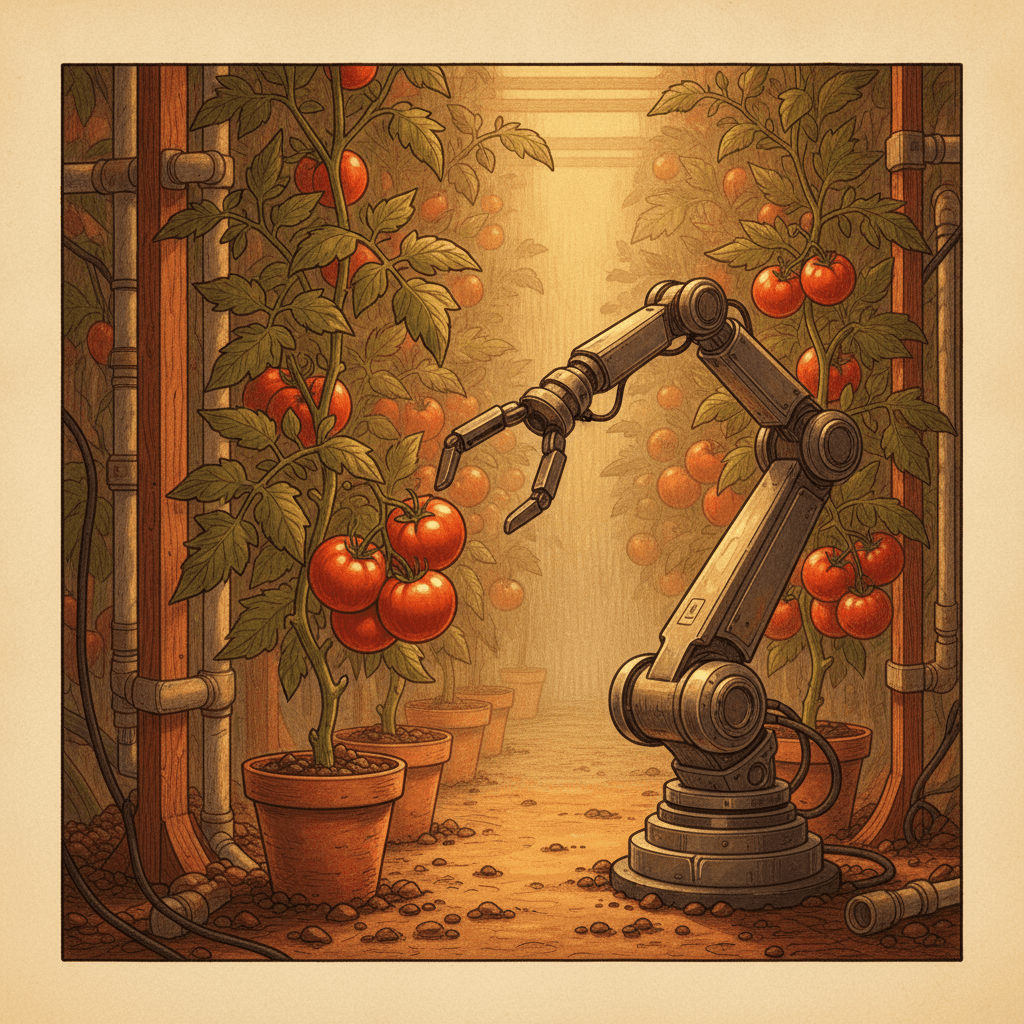
The core idea is that robots build a "value cache," which is essentially a short-term memory of how well their past actions achieved a goal. If a robot is trying to pick a delicate tomato, for instance, it remembers how its grip pressure affected previous tomatoes. This memory helps it choose better actions next time, even if the new tomato is slightly different in ripeness or size. This isn't a complex, human-like memory, but rather a simple, efficient record of success probabilities. This technique helped robots achieve a 29.4% gain in success rate in complex tasks involving squishy objects.
Normally, robots are trained offline, meaning they learn from huge datasets in a simulation before ever touching a real object. That's like practicing driving in a video game and then expecting to nail parallel parking on a busy street without any real-world practice. The VaM system, however, combines this initial offline training with continuous "online learning." This means the robot keeps learning and improving its actions while it's actually doing the task, using feedback from its environment to refine its understanding. It's like having a driving instructor in the car with you, giving live tips as you go.
Learning From Every Move, Not Just Code
What makes this truly powerful is the way robots use "online reinforcement learning." Reinforcement learning is a method where a machine learns to make decisions by trying things out and getting rewards or penalties, much like a dog learning tricks through treats and scolding. But here, the robots aren't just learning from success; they're also learning from "off-policy interventions"—basically, when a human guides them or corrects a mistake. This means a human can step in to show the robot how to do something better, and the robot immediately incorporates that lesson into its ongoing learning. This kind of hands-on teaching speeds up the learning process dramatically.
Researchers at institutions like the University of California, Berkeley, have been instrumental in developing these adaptive learning frameworks. They found that this continuous, real-world learning allows robots to perform 8 times as many "policy iterations" (essentially, internal practice runs) using the same computational resources. Imagine how quickly a human could learn if they could instantly retry a difficult task eight times faster in their head. The combination of value caching and online learning resulted in a 32.8% gain in success rate over robots that only relied on traditional offline training. This also means future farm technology could become much more versatile, solving various problems without needing extensive, new reprogramming for each one, especially for complex operations like how farmers may grow food with less water or even something as specific as why some farm plants never get sick.
Overcoming Real-World Challenges
The biggest hurdle for robots in real-world scenarios has always been "partial observability." This is when a robot can't see or sense everything it needs to know about a situation. Think of trying to grasp a ripe fruit hidden partly by leaves; a human might instinctively feel for it, but a robot struggles if its cameras can't see the whole picture. The value caching acts like a mental model, letting the robot estimate what it can't directly see based on past experiences, making smarter guesses. This helps the robot navigate complex interactions, especially when dealing with "deformable objects" – things that change shape when you touch them, like dough or a ripe peach.
This ongoing adaptation makes the robots incredibly efficient. They are recording more than twice as low time per gradient step—meaning they process new information and adjust their internal models faster. This isn't just about speed, but about smarter learning that compounds over time. While we're likely still 5-10 years away from widespread deployment of fully autonomous, self-improving farm robots on every farm, the progress shown in these laboratory settings is significant. When fully realized, this technology could lead to a massive leap in agricultural productivity, allowing more precise care for individual plants and less waste. It could even make it easier for farmers to grow a wider variety of crops in challenging environments, complementing efforts to make your farm can grow food even with salt.
The Future of Your Food
This kind of robot intelligence means less crop damage, more precise harvesting, and potentially lower food costs for you. Instead of large, clunky machines, imagine nimble robots moving through fields, gently inspecting each plant, and picking only what’s perfectly ripe. They would learn the subtle differences between a ready-to-pick strawberry and one that needs another day, all on their own. This shift from programmed automation to self-improving autonomy is a quiet but powerful change in how our food supply will operate, potentially leading to more sustainable and efficient farms worldwide.
Key Takeaways
- Farming robots are learning to adapt and improve their performance in real-time, just like a human learns on the job.
- A "value cache" gives robots a short-term memory of past successes, helping them make smarter decisions when encountering new, similar situations.
- This approach combines initial training with continuous real-world learning, leading to significant increases in success rates for complex tasks involving delicate or deformable objects.
Frequently Asked Questions
What is online learning for robots? Online learning allows robots to continuously improve their skills while performing tasks in the real world, integrating new experiences and feedback on the fly, similar to how a person learns from practice.
How does "Value as Memory" help robots? VaM provides robots with a short-term memory of how successful past actions were, helping them make better decisions in new, similar situations by predicting outcomes and reducing ambiguity.
Why is this important for agriculture? This technology helps farm robots handle unpredictable real-world conditions like uneven terrain or delicate crops, leading to more efficient harvesting, less waste, and greater productivity on farms.
Editorial note: The scientific findings presented in this article are sourced exclusively from published research papers, peer-reviewed studies, certified inventions, and registered patent filings. Images generated by AI.
Stay ahead of the curve
The science that shapes tomorrow — in your inbox every week
The scientific findings presented in our articles are sourced from published research papers, peer-reviewed studies, certified inventions, and registered patent filings. Subscribe for focused weekly coverage, hands-on explainers, and practical insights that help you stay curious — no jargon, no noise.
By subscribing, you agree to receive newsletter and marketing emails, and accept our Terms of Use and Privacy Policy. You can unsubscribe anytime.
Sustainable Food Systems, Mediterranean Agriculture & Food Waste Innovation
Italian food systems journalist writing about the science of producing food more sustainably — and wasting far less of it.
View full profile →