Robots Just Learned How You Feel Objects
Ever tried to pick up a wet bar of soap or a flimsy sheet of paper? Robots struggle with this daily, often dropping or crushing things. New research is teaching machines how to "feel" an object's weight, slipperiness, and firmness just like you do.

You know instantly when a glass is about to slip from your hand or if that plastic bottle will crumple under your grip. This isn't magic; it's your brain combining what you see with the subtle pressures your fingers feel. For robots, this kind of common sense about objects has been a huge hurdle, leading to countless dropped mugs or squashed tomatoes. They simply don't understand an object's physical properties—how heavy it is, how slippery, or how firm. But now, that’s beginning to change, as scientists have found a clever way to teach robots this vital human skill.
This new system, called ViTacPhys, lets robots learn how to grasp objects by watching and feeling human demonstrations. Think of it like a child learning to sort toys: they watch an adult pick up a heavy block, a squishy ball, and a smooth marble, then try it themselves, learning from each success and fumble. The robot isn't just mimicking the movement; it’s actually estimating crucial details like an object's mass (how heavy it is), its friction coefficient (how slippery it feels), and its stiffness (how hard or squishy it is). This detailed understanding allows the robot to adapt its grip in real-time.
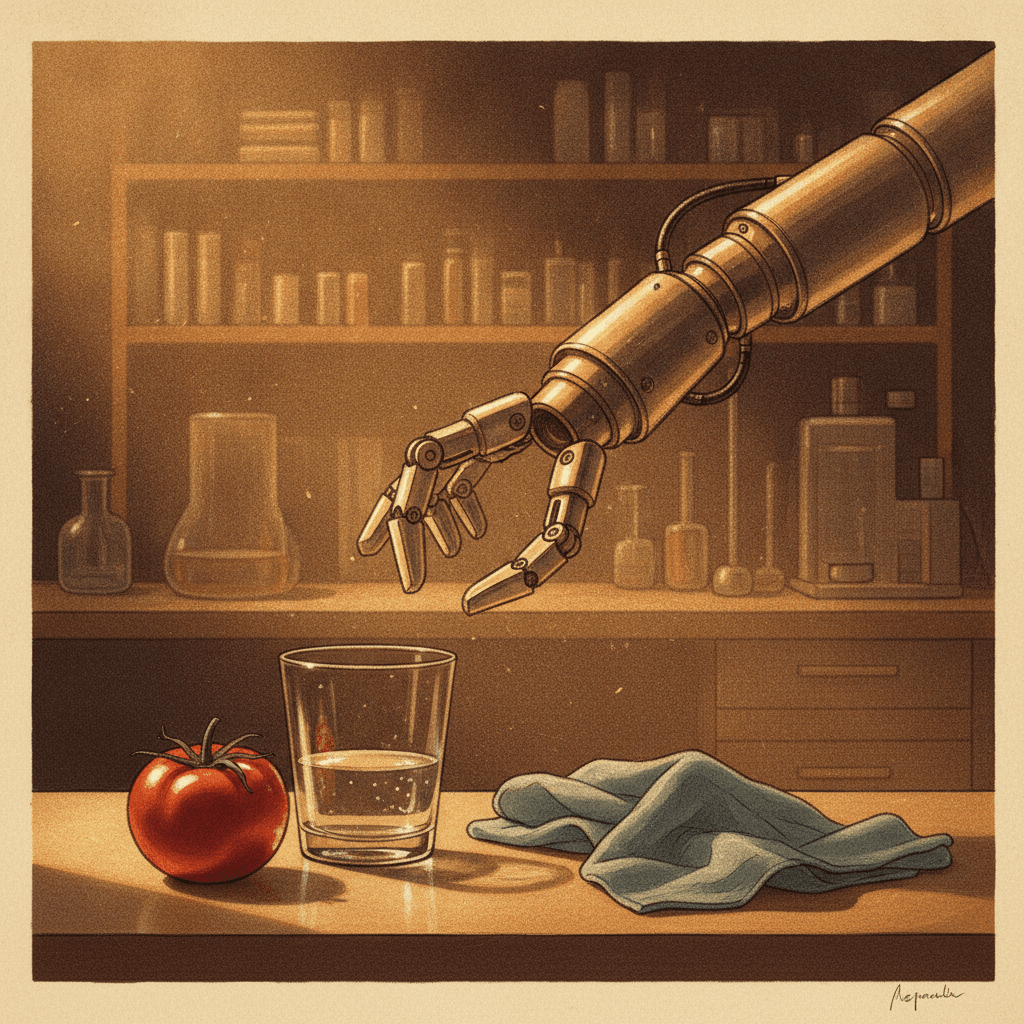
Image alt text: HERO: A robot arm with a delicate gripper gently reaching for a collection of everyday objects like a ripe tomato, a glass, and a soft cloth, all bathed in warm, dramatic amber light within a dimly lit lab. Volumetric haze fills the background, creating a sense of depth and focus on the robot's precision.
Why Robots Struggle to Feel Like Us
The core problem for robots is that most vision-based systems only "see" an object's shape and position, like looking at a picture. They don't have the rich sensory input our fingers provide, which tells us so much about what we're holding. Without this "feel," a robot might apply too much force to a delicate egg or too little to a slippery mug. This is why many automated systems excel at repetitive, predictable tasks, but struggle with the everyday variability of our world, where objects come in countless textures and densities.
ViTacPhys tackles this by combining visual data (what the human sees and how they move) with tactile data (the pressure and vibration sensors on the human's hand). It then uses a sophisticated AI model, like a super-smart detective, to cross-reference these inputs. This cross-attention multimodal fusion helps the system understand how visual cues (like the way a soft sponge deforms) correspond to tactile sensations (like its squishiness). This isn't just about mimicry; it’s about learning the underlying physics of how objects interact with force.
Image alt text: SECTION1: A close-up, intimate shot of human fingers gently pinching a soft, deformable object like a ripe peach or a foam block. Warm, dramatic key light illuminates the textures of skin and fruit, with deep shadows in the background creating bokeh.
Teaching Robots to Understand Object Properties
This system learns in two key ways: first, by classifying objects into categories you already understand. For example, it can tell if something is "heavy" or "light," and "high friction" (like sandpaper) or "low friction" (like ice). It achieves an impressive 97.2% accuracy for mass and 98.8% for friction on objects it has already seen. Second, for stiffness, it provides a continuous value, so it knows if something is "a little squishy" or "very firm," similar to how your body could print its own new bone with precise material properties.
The magic truly happens when ViTacPhys transfers this human knowledge to a robot. Researchers used a small amount of robot-specific training, like a brief masterclass, combined with augmented human demonstrations. This means the human training videos were slightly altered to look more like what a robot's camera would see, bridging the gap between human and machine perception. The robot then learns to apply this newfound "feel" for objects, resulting in more adaptive grasping.
Adaptive Grasping: Robots That Feel
When tested, robots using ViTacPhys achieved a 95% success rate grasping familiar objects and 83.4% on totally new, unfamiliar objects. This is a significant leap compared to previous methods, which often struggled with the unexpected. What’s really compelling is that when these robots successfully grasped unfamiliar items, the force they applied was more consistent with what a human teleoperator would use. This suggests a more intuitive, human-like understanding of the objects, not just brute-force gripping. Imagine a robot sorting delicate medical supplies or handling fragile food items in a factory; this level of dexterity is crucial. The ability to precisely control forces based on object properties could also extend to other areas, such as when robot farmers are starting to think for themselves and need to handle diverse crops.
One surprising fact is that this system can successfully grasp objects it has never seen before with such high accuracy. This "generalization" is notoriously difficult for AI, which usually excels only at tasks it's been specifically trained for. It's like teaching a child to pick up a specific toy, and then they can suddenly pick up any toy, even one they’ve never encountered.
Image alt text: SECTION2: A robot arm in a bustling, warmly lit warehouse setting, carefully placing different sized and shaped boxes onto a shelf. Dramatic shafts of amber light pierce through high windows, illuminating dust motes and creating a busy, productive atmosphere.
This research, published as a preprint on arXiv in July 2024 by researchers like Yiheng Liu and Siyuan Qiao from Carnegie Mellon University, marks a clear path towards robots that are truly adaptable. We are likely still 5-10 years away from widespread deployment in complex, unstructured environments like our homes, but the implications for manufacturing, logistics, and even elder care are immense. Imagine a future where your home robot can truly understand the difference between a glass, a piece of fruit, and a stack of papers, handling each with the gentle confidence you do.
Image alt text: SECTION3: A close-up on the intricate, textured surface of a robotic gripper's finger, illuminated by a warm, focused light source. Deep shadows emphasize the subtle details and sensors, creating a moody, painterly feel.
Key Takeaways
- Robots can now learn an object's weight, slipperiness, and firmness by observing human interaction.
- The ViTacPhys system combines visual and tactile data, enabling robots to adapt their grip for unfamiliar objects.
- This breakthrough promises more dexterous and reliable robots for tasks ranging from manufacturing to household assistance.
Frequently Asked Questions
What is ViTacPhys? ViTacPhys is an AI framework that teaches robots to estimate an object's physical properties like mass, slipperiness, and firmness by watching and feeling human manipulation demonstrations, allowing for more adaptive grasping.
How does ViTacPhys help robots grasp objects better? It helps robots grasp better by combining visual information with tactile feedback to understand an object's unique properties. This allows the robot to adjust its grip and force precisely, preventing drops or damage.
Why is understanding object properties important for robots? Understanding object properties is crucial because it enables robots to handle a wider variety of items, especially delicate or irregularly shaped ones, with the dexterity and care needed for tasks in factories, warehouses, or even homes.
Editorial note: The scientific findings presented in this article are sourced exclusively from published research papers, peer-reviewed studies, certified inventions, and registered patent filings. Images generated by AI.
Stay ahead of the curve
The science that shapes tomorrow — in your inbox every week
The scientific findings presented in our articles are sourced from published research papers, peer-reviewed studies, certified inventions, and registered patent filings. Subscribe for focused weekly coverage, hands-on explainers, and practical insights that help you stay curious — no jargon, no noise.
By subscribing, you agree to receive newsletter and marketing emails, and accept our Terms of Use and Privacy Policy. You can unsubscribe anytime.
AI in Healthcare, Biomedical Computing & Drug Discovery Algorithms
Computational biologist and science journalist covering the remarkable collision of artificial intelligence with medical research.
View full profile →