Your Heart Scans May Soon See Hidden Damage
Heart attacks remain a leading killer, but current scans can miss early damage. New AI could soon spot subtle clues in your heart's movement, offering doctors a chance to intervene sooner and potentially save lives.
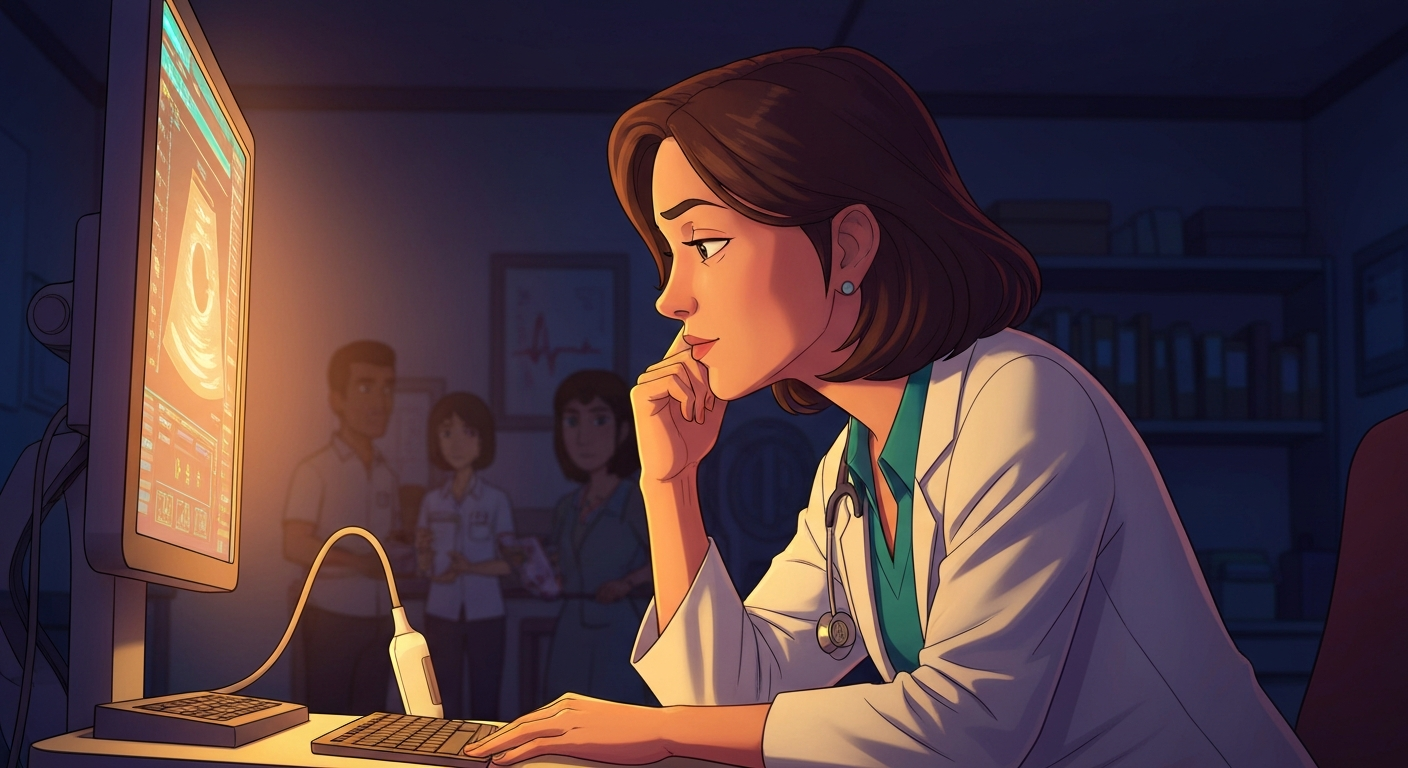
Could a computer watch your heart beat and see trouble before a doctor can? It turns out a new approach in artificial intelligence might soon make that a reality, quietly helping medical professionals find hidden heart damage that current methods often miss. This isn't science fiction; researchers are making real strides.
Myocardial infarction, more commonly known as a heart attack, happens when blood flow to your heart suddenly stops, causing parts of the heart muscle to die. It's still a devastating problem worldwide, and catching the earliest signs of damage is critical for better outcomes. Doctors often use echocardiograms – those ultrasound scans that let them see your heart moving – to check for issues, looking especially for parts of the heart wall that aren't moving quite right.
Why Your Current Heart Scans Sometimes Miss Clues
Current methods for analyzing heart scans often rely on doctors' expert eyes or on basic computer programs that need a lot of manual guidance. Think of it like trying to describe a dance move with only a few still photos instead of a full video. These older systems struggle with the sheer complexity of heart motion and can be easily confused by subtle shifts or different viewing angles during a scan. This means that small, but important, signs of a problem might go unnoticed, especially in the early stages when intervention could make the biggest difference.
The challenge is that heart movement is incredibly nuanced, like a complex orchestral performance where every instrument (or heart segment) plays a slightly different, crucial part. If even one section isn't moving in perfect sync, it could signal an issue. Traditionally, getting computers to understand this "dance" without extensive, frame-by-frame human annotation has been nearly impossible.
How AI Is Learning to "Watch" Your Heart Beat
This isn't sci-fi. A new system called MCF-Net, developed by a team of researchers and detailed in a recent preprint on arXiv, uses a clever combination of artificial intelligence to analyze echocardiograms. They've built a "motion-guided multi-view fusion framework," which essentially means it looks at your heart from several angles at once and focuses on how different parts are moving. It’s like having a dozen expert choreographers watching your heart's every move, not just one.
The AI uses a "foundation model" called EchoPrime, which is like a highly experienced medical student who has already studied countless echocardiograms. This model extracts visual features – the shapes, textures, and movements – from two different views of your heart simultaneously. But here's the clever part: to understand motion, it doesn't need doctors to painstakingly label every single frame. Instead, it gets just one "template" frame marked by a human, then intelligently tracks points across the entire video, much like a film editor using tracking markers to follow an actor's face.
Spotting Damage Even When Your Heart Tries to Hide It
This sparse supervision is important because it means the AI can learn from much less human input, making it more practical for real-world use. The system then creates "soft masks" – think of them like gentle spotlights that highlight specific areas of the heart that show unusual movement. These masks guide the AI to focus its attention on challenging segments of the heart muscle, giving priority to areas that might be struggling. Finally, it integrates all this motion data with the visual information from both views, refining its predictions without letting the motion completely override strong visual clues. This is similar to how computer vision finally designs real materials by learning complex patterns.
This detailed, multi-faceted analysis means the AI can achieve a 72.4% F1 score and 84.9% accuracy in localizing segment-level heart damage. To put that in perspective, an F1 score is a balance of precision (how many detected problems are real) and recall (how many real problems are detected). These numbers are significantly better than approaches that only look at motion or only look at visuals. For instance, the system can spot a tiny patch of muscle struggling to contract, a sign that a human eye might easily miss amidst the heart's overall pumping action. This ability to pick up on subtle irregularities is what makes it so powerful.
What This Means for Your Future Heart Health
So, what does this mean for you? If this technology moves from research to clinics, your routine heart scans could become far more informative. Doctors would have a powerful assistant to help them spot the earliest whispers of heart damage, long before it escalates into a full-blown crisis. This could lead to earlier interventions, such as medication adjustments or lifestyle changes, potentially preventing serious heart attacks and improving long-term outcomes. Imagine a future where a quick, non-invasive scan gives you peace of mind, or alerts your doctor to a brewing problem they can address right away.
The skeptics will want to see this AI tested extensively in diverse patient populations and against a wide range of heart conditions. They'll need to prove its consistency across different ultrasound machines and operators, and ensure it doesn't produce too many "false alarms" that cause unnecessary anxiety. But the early evidence from institutions like those submitting to arXiv is compelling. This is similar to how doctors will soon see future sickness using advanced AI models.
One surprising fact is that even highly trained cardiologists can disagree on interpreting echocardiograms up to 20-30% of the time, especially for subtle issues. An AI like MCF-Net could offer a consistent, objective second opinion, reducing variability and potentially improving care for everyone. It could also free up doctors to focus on treatment plans and patient interaction, rather than spending hours meticulously analyzing scans.
While clinical deployment is likely still 5-10 years away as rigorous testing and regulatory approvals are needed, the trajectory is clear. AI is learning to see what we can’t, making our bodies' quiet signals louder and clearer. This blend of vision and motion analysis is also being explored in other medical fields, such as in understanding why some brain cancers quietly ignore drugs. The future of heart health might just depend on how well a computer can watch your heart dance.
Making Heart Scans More Accurate and Accessible
This new approach helps make heart disease detection more accurate by combining visual information with motion analysis, overcoming limitations of single-view or single-factor assessments. The AI system processes information from multiple camera angles, much like a director uses multiple cameras to capture every detail of a scene, creating a complete picture of your heart's health. This allows for earlier and more reliable identification of issues like heart attacks, which could mean earlier treatment and better health outcomes for you.

Key Takeaways
- New AI called MCF-Net significantly improves detection of heart attack damage by analyzing both visual and motion clues from multiple scan angles.
- The system learns from minimal human guidance, making it more practical for broad use in medical imaging.
- This technology could lead to earlier diagnosis and treatment for heart conditions, potentially saving lives and reducing the burden of heart disease.
Frequently Asked Questions
What is myocardial infarction? Myocardial infarction is the medical term for a heart attack, where a blockage in blood flow damages part of your heart muscle. It's a leading cause of death worldwide.
How does MCF-Net improve heart attack detection? MCF-Net combines visual features from different scan angles with subtle motion analysis to spot damaged heart muscle more accurately than current methods. It uses minimal human annotation.
When will this AI be available in hospitals? While promising, this technology is still in the research phase. It will likely take 5-10 years of further testing and regulatory approvals before it's widely used in clinical settings.
Editorial note: The scientific findings presented in this article are sourced exclusively from published research papers, peer-reviewed studies, certified inventions, and registered patent filings. Images generated by AI.
Stay ahead of the curve
The science that shapes tomorrow — in your inbox every week
The scientific findings presented in our articles are sourced from published research papers, peer-reviewed studies, certified inventions, and registered patent filings. Subscribe for focused weekly coverage, hands-on explainers, and practical insights that help you stay curious — no jargon, no noise.
By subscribing, you agree to receive newsletter and marketing emails, and accept our Terms of Use and Privacy Policy. You can unsubscribe anytime.
AI in Healthcare, Biomedical Computing & Drug Discovery Algorithms
Computational biologist and science journalist covering the remarkable collision of artificial intelligence with medical research.
View full profile →