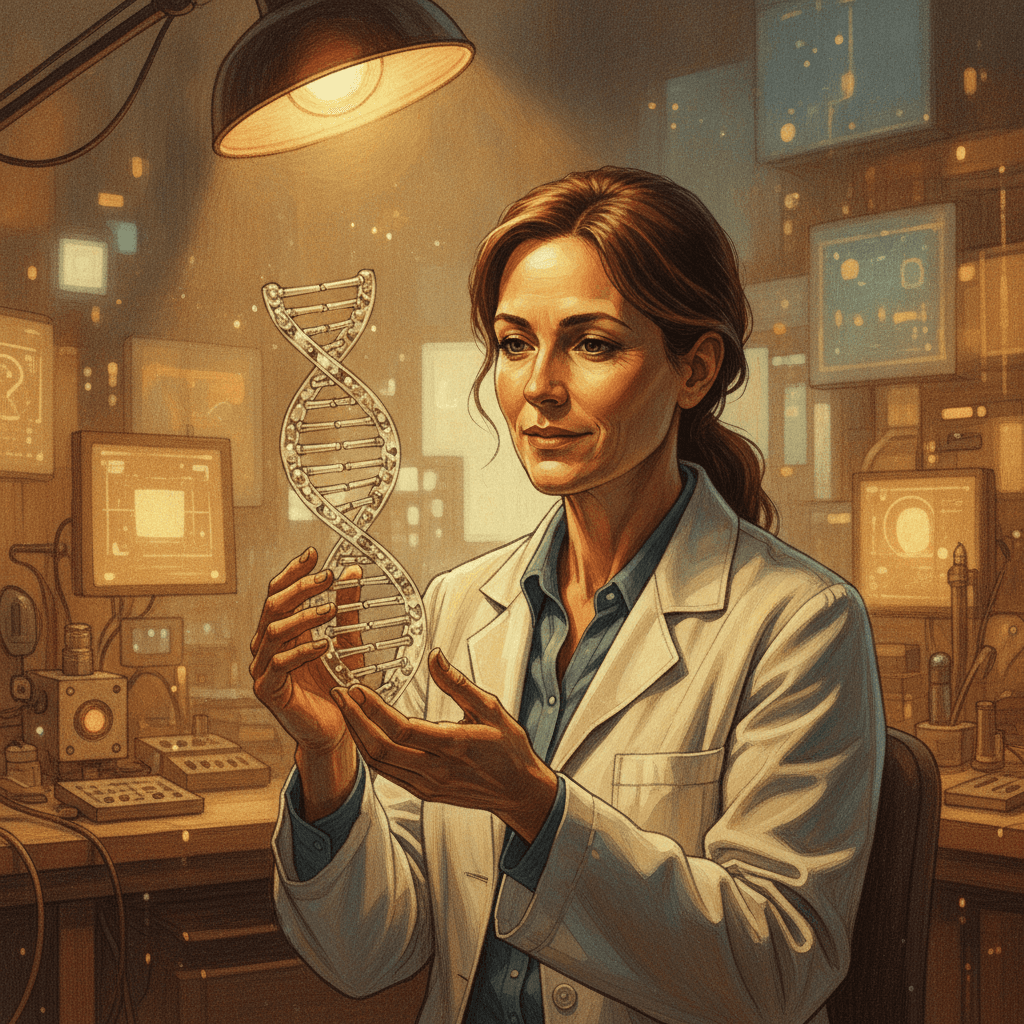
How AI Is Finally Learning Your Body's Secret Signals
Your body's cells are constantly sending out hidden messages that doctors struggle to read. New AI methods are now "listening" to these signals more accurately than ever before, promising a clearer map of your health.

Imagine if your doctor could glance at a sample of your cells and instantly know not just what kind of cells they were, but also their precise health status, like reading a detailed health report from each individual cell. This isn't a distant fantasy; it’s becoming a reality through advanced AI. We're talking about computers learning to interpret the incredibly subtle, complex language your cells use to identify themselves and signal their condition.
This incredible leap comes from the world of artificial intelligence, specifically a technique called contrastive learning. Think of it like teaching a child to identify different animals by showing them many pictures and saying "this is a dog, that is not a dog." Contrastive learning works similarly, showing the AI many examples of cell data and teaching it to spot the unique "fingerprints" of different cell types, even when they look very similar to the human eye. This method excels at identifying distinct cell types, which is a fundamental challenge in understanding diseases and developing new treatments.
Decoding Your Cells with AI
The scientific community has been grappling with how to effectively classify individual cells from single-cell RNA sequencing (scRNA-Seq) data, which is like getting a detailed list of all the active genes—the "recipes"—within a single cell. This data is incredibly rich but also incredibly noisy, like trying to pick out a specific conversation in a crowded room. That's why researchers like Dr. Jian-Yu Shi from the University of Texas Health Science Center at Houston set out to explore new methods. In his 2022 research, Dr. Shi proposed novel contrastive learning methods that act as a sophisticated "listener," filtering out the noise and amplifying the subtle signals that define each cell type.
These methods use what’s called "augmentation," which is like taking a photo of a cell and then making slight variations—rotating it, zooming in, adding a tiny bit of blur—to teach the AI that these are all still the same cell. This helps the AI build a robust internal representation of what each cell type truly looks like, regardless of minor variations. One surprising fact: supervised contrastive learning, where the AI is told what each cell type is, actually produces higher quality "feature representations"—the internal mental models the AI builds—for identifying multiple cell types than unsupervised methods, which learn without explicit labels. It’s like giving a student a few correct answers to guide their study, rather than just throwing a textbook at them.
Teaching Machines to See What Humans Miss
So, how does this actually work? Imagine you have a vast library of cell data, each representing a "transcriptome"—the complete set of RNA molecules in a cell, telling us which genes are active. Traditional methods might try to find patterns in this data, but they often struggle with the sheer volume and complexity. Contrastive learning gives the AI a powerful new lens. It learns to pull out the most important, distinctive features of each cell type. It’s a bit like a chef who, when learning to cook, isn’t just told the ingredients of a dish but is taught to identify the subtle aromas and textures that define a perfect meal, recognizing that a slightly different spice brand or cooking time still results in the same delicious outcome.
Dr. Shi's work tested these new methods on 18 different scRNA-Seq datasets, covering various organs, tissues, and species. The results consistently showed that these contrastive learning techniques achieved some of the highest accuracy rates seen to date for cell type identification. This means the AI is getting much better at differentiating between, say, a healthy lung cell and a cancerous one, or between different types of immune cells, each playing a unique role in your body's defenses. This improved ability to discern specific why your genes hide more than we knew is critical for advancing our understanding of health and disease.
The Future of Personalized Health
What does this mean for you? If this technology continues to develop at its current pace, we could see diagnostics that are much more precise, detecting diseases earlier and tailoring treatments more effectively. For example, a biopsy might not just confirm cancer, but tell doctors the exact type of cancer cells present, and even how they might respond to specific drugs, all with a higher degree of confidence. This level of detail in a simple trick finds sickness faster could fundamentally change how we approach personalized medicine.
Skeptics might point to the "black box" nature of AI—that it can be hard to understand why the AI made a certain decision. However, the rigor of these studies, evaluating performance across diverse datasets, builds trust. The next steps involve making these AI models even more robust and transparent, perhaps by helping us visualize the specific cellular features the AI is using to make its decisions. This would add another layer of certainty and insight, combining the power of machine learning with human interpretability.
The implications extend beyond disease diagnosis. Imagine understanding how your cells age differently, leading to new ways to prolong health, or how they respond to specific diets or exercise regimens, creating truly personalized wellness plans. This advanced ability for AI to map the intricate world of your individual cells is quietly shaping a future where medicine is less about treating symptoms and more about understanding and maintaining health at its most fundamental level.
Key Takeaways
- New AI methods, specifically contrastive learning, are dramatically improving the identification of different cell types from biological data.
- This AI works by learning the unique "fingerprints" of cells, much like how we learn to distinguish objects, but with incredible precision.
- More accurate cell identification can lead to earlier disease detection, more precise diagnoses, and highly personalized medical treatments.

Frequently Asked Questions
What is cell type identification? Cell type identification is the process of distinguishing different kinds of cells in a biological sample, crucial for understanding how various cells contribute to health and disease, like identifying immune cells versus skin cells.
How does contrastive learning help with this? Contrastive learning teaches AI to find subtle patterns in complex cell data by comparing many examples. It helps the AI recognize specific cell types even with variations, similar to how a human learns to spot faces.
Why does this matter for my health? More accurate cell identification means doctors can better understand diseases at a cellular level, leading to earlier diagnoses, more targeted therapies, and potentially new ways to track your body's specific responses to treatments.
Editorial note: The scientific findings presented in this article are sourced exclusively from published research papers, peer-reviewed studies, certified inventions, and registered patent filings. Images generated by AI.
Stay ahead of the curve
The science that shapes tomorrow — in your inbox every week
The scientific findings presented in our articles are sourced from published research papers, peer-reviewed studies, certified inventions, and registered patent filings. Subscribe for focused weekly coverage, hands-on explainers, and practical insights that help you stay curious — no jargon, no noise.
By subscribing, you agree to receive newsletter and marketing emails, and accept our Terms of Use and Privacy Policy. You can unsubscribe anytime.
AI Ethics, Algorithmic Bias & Responsible Computing
Technology ethicist and journalist covering the human consequences of the decisions embedded in algorithms and AI systems.
View full profile →