Your Trash Will Quietly Power Your Home
Imagine your discarded plastic bottles and containers doing more than just sitting in a landfill. New science is finally turning that everyday waste into a valuable energy source, potentially fueling your home.
You know that feeling when you toss a plastic bottle into the recycling bin, hoping it’ll become something new? Maybe a park bench, or even another bottle, right? But what if a lot of that plastic, the kind that’s often too mixed or dirty for traditional recycling, could actually end up powering your home?
For years, we’ve been grappling with mountains of plastic waste. Globally, we produce over 380 million tons of plastic waste annually, yet a surprising fact is that only about 9% of it actually gets recycled. The rest either piles up in landfills, slowly degrading and potentially leaching chemicals, or ends up polluting our oceans and ecosystems for centuries.
This leaves us in a bind. We desperately need better ways to handle this persistent problem. Traditional recycling, while important, can't manage all types of plastic, especially when different plastics are combined or contaminated.
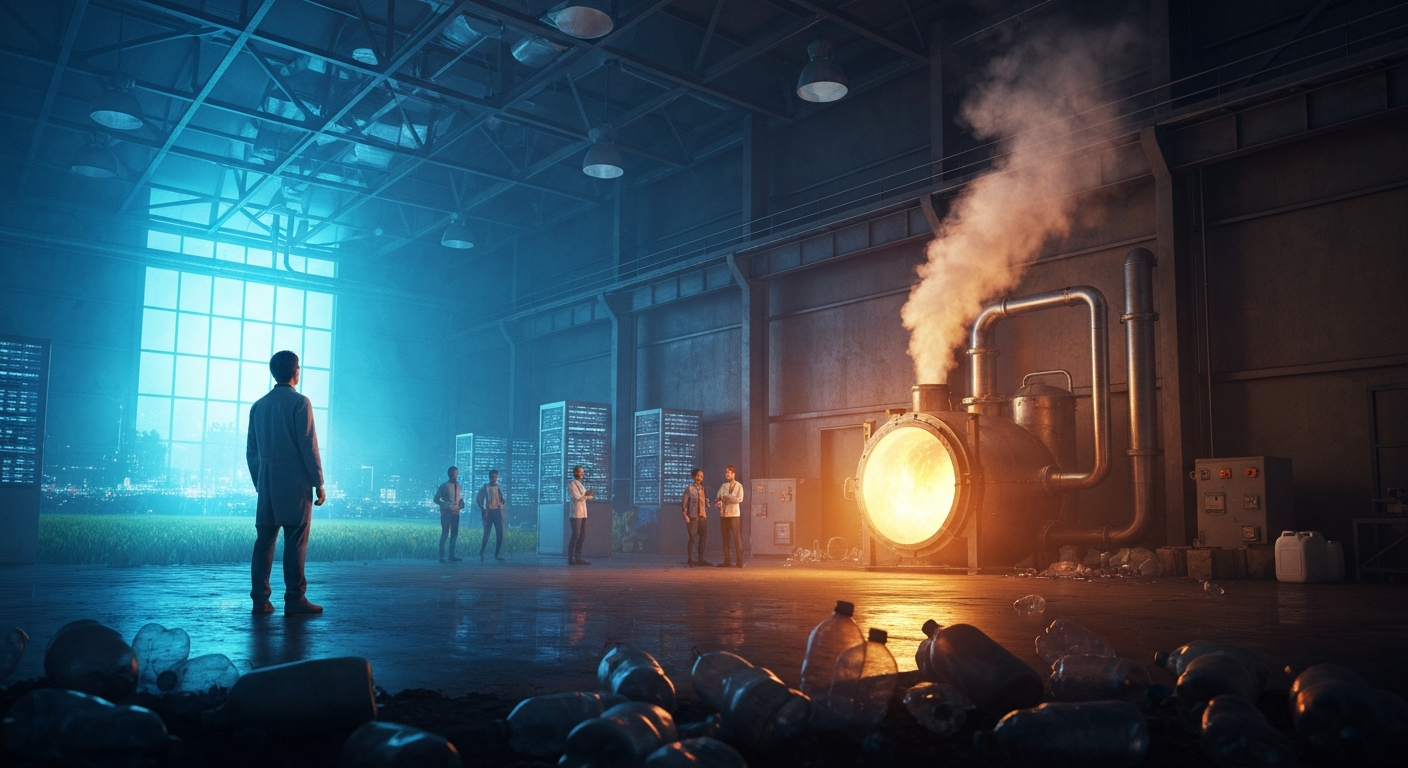
But now, scientists are quietly turning this massive problem into a surprising solution. They’re perfecting a process called pyrolysis, which is like cooking plastic at super high temperatures in a sealed oven, starved of oxygen. Instead of burning it to ash, they're breaking it down into valuable, reusable liquids and gases: fuel and hydrogen.
How Cooking Plastic Without Fire Creates Energy
Pyrolysis is a method to break down materials using intense heat in an environment completely free of oxygen. Imagine putting a plastic toy into a very hot, sealed pressure cooker instead of an open flame; it doesn't catch fire, but it melts and vaporizes into gas. This vapor then cools and condenses, much like steam turning back into water, leaving behind a liquid similar to the diesel or gasoline you might put in your car, along with some useful gases.
This isn't just a hopeful idea; researchers have extensively simulated and refined this process using specialized software, proving its effectiveness in converting mixed plastic waste. They've discovered precise conditions that optimize the yields of different energy products, making this a truly practical approach.
Your Everyday Trash Can Become Valuable Energy
Yes, your everyday trash, particularly mixed plastic waste, can become a source of valuable energy. The pyrolysis system takes those hard-to-recycle items—like yogurt cups, various packaging films, and mixed plastic containers that often get rejected by regular recycling facilities—and heats them up. Through careful control of heat and pressure, it precisely cracks apart the long, complex plastic molecules into smaller, simpler ones that make up useful fuels.
For instance, studies show that you can maximize the production of liquid fuel by running the process at around 460 degrees Celsius (about 860 degrees Fahrenheit) and standard atmospheric pressure. This means that a significant portion of our discarded plastic could be directly generating energy. Think about that: waste that once seemed useless could soon be contributing to our power grid instead of lingering in a landfill, transforming a liability into a resource for your daily life.

Beyond Fuel: Unlocking Hydrogen from Waste
This technology offers more than just liquid fuel; it also provides a path to generate hydrogen, a famously clean-burning gas. By tweaking the process conditions, specifically by increasing the temperature to 700 degrees Celsius (1292 degrees Fahrenheit) and introducing steam, researchers can maximize hydrogen production. This integrated approach, often called in-line steam reforming, is a clever way to extract even more value from plastic waste.
Hydrogen is incredibly exciting because when it burns, its only byproduct is water vapor, making it a truly clean fuel for vehicles, power plants, and potentially even heating systems. This capability could help clean up our air, offering a surprising boost to the hydrogen economy. While hydrogen has its own considerations, as we discussed in Hydrogen Fuel Has A Surprising Hidden Cost, deriving it from waste makes the prospect even more compelling.
Smart Engineering Makes it Sustainable (and Cheaper)
Making this process efficient and cost-effective is a major focus. Running a system at such high temperatures requires a lot of energy, which can make it expensive and less environmentally friendly if not managed correctly. However, engineers have designed intelligent heat recovery systems. This means they use the heat generated within the pyrolysis process itself to power other parts of the system.
It's like using the exhaust heat from your oven to pre-warm the incoming ingredients, making the whole cooking process more efficient and using less external electricity. This efficient heat recovery significantly reduces the external energy consumption required, boosting the process's overall sustainability and making it more economically viable. This kind of smart engineering is crucial for scaling up waste-to-energy technologies, aligning with the idea that Your Power Could Flow Without Any Waste.
The Real Timeline for Your Plastic's New Life
So, when can you expect to see these waste-to-energy facilities becoming common in your area? While the science behind converting plastic waste into fuel and hydrogen is strong and highly promising, bringing it to a large scale takes time and significant investment. We’re realistically looking at a timeline of 5-10 years before these plants are widely adopted. The economic viability, which relies on a consistent supply of plastic waste and stable energy prices, is still being optimized.
This isn't just about the technology working; it's about building the necessary infrastructure, securing funding, and ensuring the systems make financial sense for communities and businesses. However, the progress is undeniable. This method offers a genuine path to tackle plastic pollution while simultaneously creating new, valuable energy sources, moving us rapidly towards a more circular economy where waste is seen as a resource. It's a forward-thinking approach to problems, much like considering how Your Dinner Could Be Powered By Water.
So, the next time you hold a plastic bottle, remember it's not just trash. With a little scientific ingenuity, that everyday item could quietly become the energy that lights your home, fuels your commute, or even powers the future. It's a powerful reminder that sometimes, the biggest solutions are hidden in the problems we already have.
Key Takeaways
- Pyrolysis converts difficult-to-recycle plastic waste into usable liquid fuels and clean hydrogen gas, significantly reducing landfill pollution.
- Optimized conditions (e.g., 460°C for fuel, 700°C for hydrogen) and smart heat recovery systems make the process energy-efficient and economically viable.
- While large-scale implementation is 5-10 years away, this technology represents a powerful strategy for a circular economy, transforming plastic waste into a valuable energy resource.
Frequently Asked Questions
What is plastic pyrolysis? It's a process that heats plastic waste in an oxygen-free environment, breaking it down into valuable liquids (fuel) and gases (like hydrogen), rather than burning it or letting it sit in a landfill.
Can all types of plastic be used for this? Yes, one of the key benefits is that pyrolysis can process mixed plastic waste, including types often rejected by traditional mechanical recycling due to contamination or material complexity.
When will this technology be widespread? While the science is proven, large-scale adoption for plastic-to-fuel pyrolysis is realistically 5-10 years away. It requires significant infrastructure development and economic optimization to become common.
Is the fuel produced environmentally friendly? Yes, the fuels produced from pyrolysis, especially hydrogen, are considered environmentally friendly. They reduce plastic waste, and hydrogen burns without emitting carbon dioxide, only water vapor.
Editorial note: The scientific findings presented in this article are sourced exclusively from published research papers, peer-reviewed studies, certified inventions, and registered patent filings. Images generated by AI.
Stay ahead of the curve
The science that shapes tomorrow — in your inbox every week
The scientific findings presented in our articles are sourced from published research papers, peer-reviewed studies, certified inventions, and registered patent filings. Subscribe for focused weekly coverage, hands-on explainers, and practical insights that help you stay curious — no jargon, no noise.
By subscribing, you agree to receive newsletter and marketing emails, and accept our Terms of Use and Privacy Policy. You can unsubscribe anytime.
Hydrogen Energy, Carbon Capture & Electrochemistry
Materials scientist turned writer, tracking the chemistry that could make a genuinely zero-carbon world possible.
View full profile →