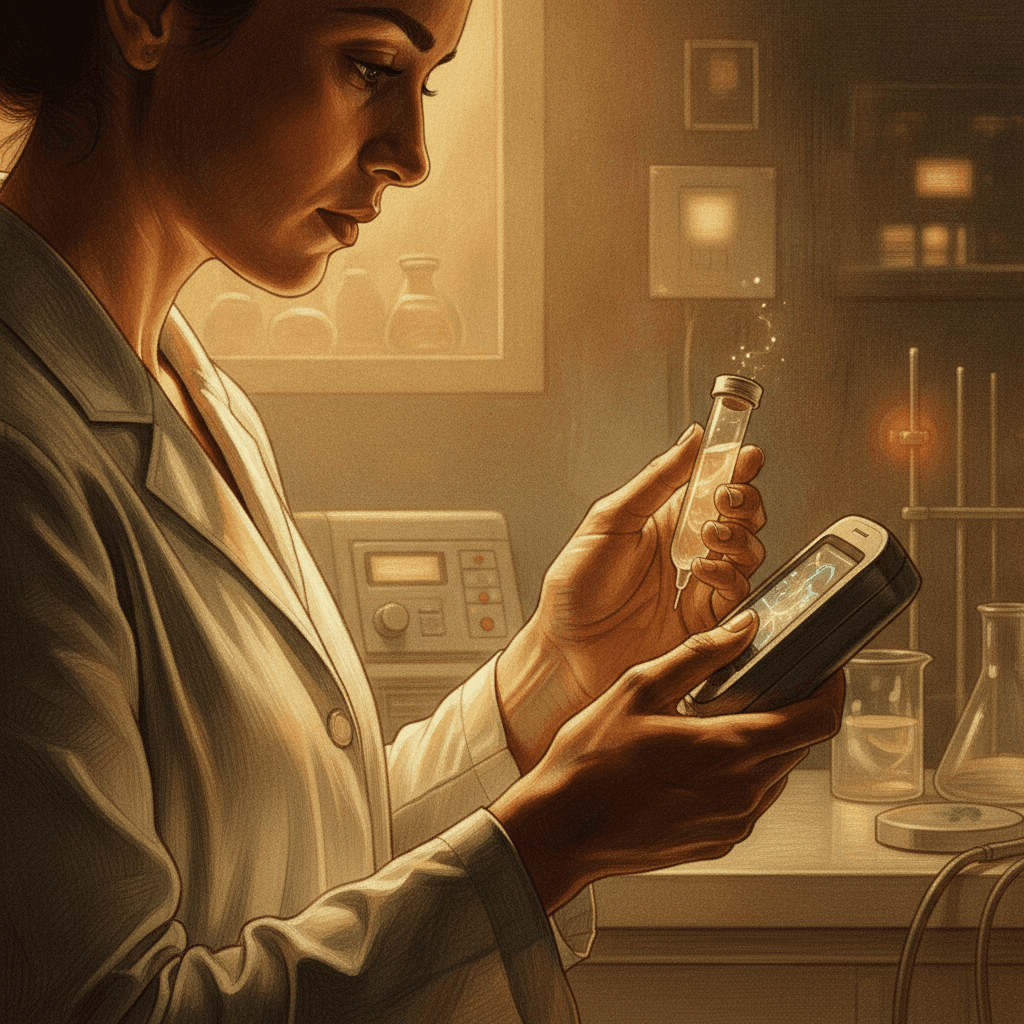
Your Phone Camera Could Spot Sickness Early
A routine photo might reveal molecular clues your doctor usually needs a blood draw to find. New research shows your phone's camera could become an early-warning system for your health.

Sometimes, the biggest leaps in science come from finding new uses for everyday tools. What if your phone's camera, the one you use to snap selfies and cat videos, could quietly peer into your body and tell your doctor what’s going on at a molecular level? This isn't science fiction anymore. Researchers are making huge strides in using simple images to understand the complex chemistry happening inside your cells, hinting at a future where catching sickness early becomes as easy as taking a picture.
Your Phone Could Soon See Molecular Secrets
This isn't sci-fi from a glossy magazine; it's real, peer-reviewed science emerging from institutions like the California Institute of Technology. Dr. Changhuei Yang and his team have developed a framework called Pic2Spec that learns to reconstruct detailed molecular "fingerprints" from regular brightfield images – the kind of pictures your microscope, or even eventually your phone, takes. They're essentially teaching computers to see the invisible, making complex biological insights accessible without fancy equipment.
Think of it like this: imagine you have a unique fingerprint made of music notes. A regular camera sees the shape of your hand (the brightfield image), but it can't hear the music. Specialized instruments, called Raman spectroscopes, can "listen" to the molecular vibrations within your cells, giving them a specific musical score that tells scientists exactly what's inside – whether it's more fat, protein, or DNA, like a unique biochemical signature. Raman spectroscopy is like a super-sensitive microphone that identifies molecules by how they vibrate when light hits them. However, these machines are slow, bulky, and expensive, which makes them hard to use for quickly checking lots of cells.
Pic2Spec acts like a highly trained musical prodigy who can look at the shape of your hand and accurately guess your unique musical fingerprint. It learns the subtle visual cues in a cell's shape and texture that correspond to its molecular composition. This means you could potentially get detailed molecular information from just a simple image, sidestepping the need for those specialized, time-consuming Raman machines. The team has already validated Pic2Spec across mammalian and bacterial cells, accurately generating spectra with 98% similarity to real measurements.
How Your Camera Learns to Read Your Cells
The core of Pic2Spec is something called generative modeling, which is like teaching a painter to create new artwork based on examples. The model learns a "shared latent biochemical representation" – basically, it figures out the hidden connections between what a cell looks like and what it's made of at a chemical level. It creates a bridge between image morphology (the cell's shape and structure) and its vibrational spectral structure (its molecular fingerprint).
This means the system can "virtually" perform Raman spectroscopy without any special hardware. For instance, in bacterial cells, the generated spectra could even tell the difference between tiny, mutation-driven genetic changes and predict protein expression with accuracy very close to actual Raman measurements. It's like being able to tell what kind of car is under a tarp just by looking at the subtle bumps and curves of the cover, even though you can't see the engine. This ability to get a molecular picture of disease is a game-changer.
One surprising fact? The technology outperforms traditional image analysis by 20% in specific molecular-level predictions. This isn't just a slight improvement; it's a significant leap in how much information we can pull from a simple photograph.
Why Skeptics Still Have Questions
Of course, no new technology comes without its challenges. Skeptics would want to see how this holds up in real-world clinical settings, beyond the lab bench. Does it work as well with diverse patient samples, which often have more variability than controlled lab cultures? How robust is it against different lighting conditions or camera qualities? The ability to spot sickness sooner depends on consistent accuracy.
They would also question the scope – while it's impressive for cell cultures, can it be applied to more complex tissues or even directly within the human body? Researchers would need to prove its reliability across a much broader range of biological samples and clinical conditions to move it from a promising tool to a standard diagnostic method. This kind of hidden map of future sickness requires rigorous testing.
What This Means for Your Future Health
If Pic2Spec, or similar methods, become widely adopted, it could redefine how we approach diagnostics. Imagine quick, non-invasive screenings where a clinic simply takes a picture of your cells, maybe from a cheek swab, and immediately gets molecular insights into your health. This could democratize label-free biochemical phenotyping, meaning more people could access detailed health information without expensive lab tests or procedures.
It means faster detection for conditions like early cancer markers, bacterial infections, or even monitoring cell responses to drugs, all at the scale and accessibility of standard microscopy. Picture a world where a quick snap from a doctor’s simple microscope could tell them if a tumor is responding to treatment or if a particular bacterial strain is present. This could massively speed up diagnosis and treatment, ultimately saving countless lives. While widespread clinical use is still probably a decade away, the foundational science is firmly in place.

Key Takeaways
- Your phone's camera might soon reveal cellular molecular details, predicting health issues earlier than ever before.
- The Pic2Spec system uses AI to 'virtually' perform complex molecular analysis from simple images, bypassing expensive lab equipment.
- This could lead to much faster, more accessible, and less invasive medical diagnostics for a wide range of conditions.
Frequently Asked Questions
What is Pic2Spec? Pic2Spec is a framework that uses generative AI to reconstruct detailed molecular fingerprints, called Raman spectra, from simple brightfield microscopy images of cells. It learns the link between a cell's visual appearance and its chemical makeup.
How accurate is Pic2Spec? It generates molecular spectra with 98% cosine similarity and about 95% Pearson correlations compared to actual Raman measurements. It can even predict subtle genetic and protein expression changes with high accuracy.
Why does this matter for health? This method could enable fast, label-free molecular analysis for clinical diagnostics, screening, and monitoring. It makes complex biochemical information accessible using standard, affordable microscopy, removing the need for specialized, slow equipment.
When might this be available? While the research is promising, widespread clinical application in hospitals and clinics is likely still around 5-10 years away, as it requires extensive testing and validation.
Editorial note: The scientific findings presented in this article are sourced exclusively from published research papers, peer-reviewed studies, certified inventions, and registered patent filings. Images generated by AI.
Stay ahead of the curve
The science that shapes tomorrow — in your inbox every week
The scientific findings presented in our articles are sourced from published research papers, peer-reviewed studies, certified inventions, and registered patent filings. Subscribe for focused weekly coverage, hands-on explainers, and practical insights that help you stay curious — no jargon, no noise.
By subscribing, you agree to receive newsletter and marketing emails, and accept our Terms of Use and Privacy Policy. You can unsubscribe anytime.
Health, Mental Health & Neuroscience
European health correspondent exploring the science of the human brain and behaviour.
View full profile →