Your Farm Will Soon Know What Crops Need
Imagine a sensor that instantly tells you if a plant is sick or needs water, without touching it. New technology is making this a reality, promising to save billions in crop losses and change how we grow food.
Could a hidden digital brain soon tell farmers exactly what's happening inside every plant on their land? This idea sounds like something out of science fiction, but new technology is bringing it closer to reality right now, promising to reshape how we manage food production and predict crop health. Researchers have developed a powerful AI model, dubbed UltraIR, that acts like a universal translator for tiny chemical signals, allowing it to "understand" what molecules are doing in complex mixtures, from soil to living plants.
Think of it like giving a chef super-smell: instead of just guessing what's in a dish, they can instantly identify every ingredient and its exact quantity just by sniffing. UltraIR does something similar for infrared spectroscopy, a technique that "sees" the unique chemical fingerprints of substances. Usually, interpreting these fingerprints is really tough, requiring experts and huge libraries of known chemical patterns. But UltraIR skips all that, learning to identify these patterns from simulated data, then applying that knowledge to real-world samples with surprising accuracy.
Teaching AI to "See" Invisible Chemical Signals This AI model, with over 100 million internal connections (like a massive digital brain), learned by looking at 60 million simulated infrared "fingerprints." These simulations taught it to recognize tiny molecular structures and predict how chemicals interact, even without seeing real-world examples first. It's similar to how a language AI learns grammar rules from billions of sentences online before it ever tries to write its own story. This pre-training makes UltraIR incredibly versatile.
Once it's learned the basics, UltraIR can then be fine-tuned for specific tasks, even with very little new information. It can do things like identifying what functional groups, the small groupings of atoms that determine a molecule's behavior, are present in a sample. It can also help figure out the exact molecular structure of unknown compounds, predict how a substance will behave physically or chemically, and even break down complex mixtures to tell you every component.
More Than Just a Chemical Sleuth The real magic is its ability to learn from simulations and then instantly apply that knowledge to the messy, complicated world outside the lab. This "simulation-to-real" transfer learning is why UltraIR is so powerful; it doesn't need huge amounts of real-world data to start working, a major bottleneck for most AI systems. It can even make sense of data from different types of infrared sensors, something previous AI struggled with.
For example, UltraIR can classify bacteria, trace the geographic origin of medicinal herbs, identify and quantify microplastics, and even predict soil properties like nitrogen levels or water content. This last point is huge for agriculture, as knowing precise soil conditions means farmers can apply how soil bacteria fix nitrogen or why seeds need cold temperatures or even how much water is truly needed.
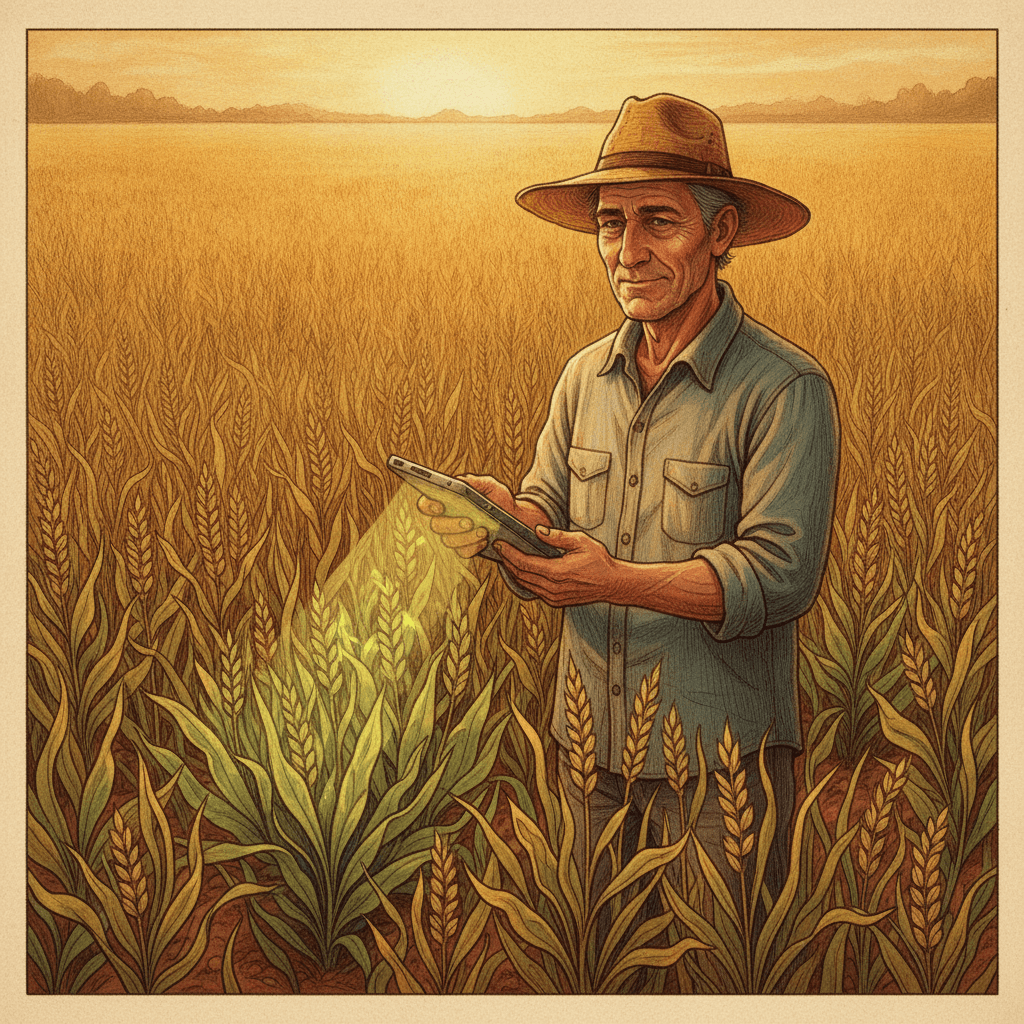
What This Means for Your Food Right now, monitoring crop health is often a guessing game or requires expensive, time-consuming lab tests. Farmers might visually inspect plants for signs of disease or nutrient deficiencies, but by then, it might be too late. UltraIR could change that entirely. Imagine a small, handheld sensor that a farmer could walk through a field, instantly getting a readout of nutrient levels, disease markers, or even stress signals from the plants themselves. This could mean knowing a crop needs more zinc before leaves start to yellow, or identifying a fungal infection days before it spreads.
This approach means less wasted fertilizer, more precise irrigation, and faster responses to crop diseases, ultimately leading to more food, less environmental impact, and potentially lower prices for consumers. One surprising fact: a significant portion of global crop yields, estimated at 20-40% by the FAO, is lost annually due to pests and diseases, much of which could be prevented with earlier detection.
The Road Ahead While UltraIR shows incredible promise in research papers like the one from arXiv, getting this technology from lab to field takes time. The core AI model exists, but adapting it into robust, affordable, and easy-to-use devices for real-world agriculture will require further engineering and field trials. If progress continues at its current pace, we could see handheld or drone-mounted chemical sensors powered by this kind of AI in farmers' hands within the next 5-7 years, transforming how your crops will soon talk to you.
This isn't just about big farms either; even small-scale growers could benefit from knowing the exact needs of their plants, optimizing their yields and reducing waste. Ultimately, UltraIR represents a step towards a future where our food systems are smarter, more efficient, and more resilient to the many challenges of a changing world.
Key Takeaways
- UltraIR is an AI that interprets chemical fingerprints from infrared light, learning from millions of simulations.
- It can detect nutrient needs, diseases, and soil properties in crops, significantly reducing agricultural waste.
- This technology promises to make farming more precise and efficient, potentially leading to more affordable and sustainably grown food.
Frequently Asked Questions
What is UltraIR? UltraIR is an advanced AI model designed to interpret complex chemical signals from infrared light. It learns from simulated data, allowing it to quickly identify substances and their properties in real-world samples like plants and soil.
How does UltraIR help agriculture? It can identify plant diseases, nutrient deficiencies, and soil health issues much faster and more accurately than traditional methods. This helps farmers optimize fertilizer, water, and pest control, reducing waste and improving yields.
Is this technology available now? UltraIR is currently a research model, but its ability to analyze chemical signals with high accuracy suggests that practical applications, like handheld crop sensors, could be developed and deployed within 5-7 years.
Editorial note: The scientific findings presented in this article are sourced exclusively from published research papers, peer-reviewed studies, certified inventions, and registered patent filings. Images generated by AI.
Stay ahead of the curve
The science that shapes tomorrow — in your inbox every week
The scientific findings presented in our articles are sourced from published research papers, peer-reviewed studies, certified inventions, and registered patent filings. Subscribe for focused weekly coverage, hands-on explainers, and practical insights that help you stay curious — no jargon, no noise.
By subscribing, you agree to receive newsletter and marketing emails, and accept our Terms of Use and Privacy Policy. You can unsubscribe anytime.
Food Security, Biofortification & Agriculture in the Global South
Development journalist covering the agricultural innovations that can feed a warmer, more crowded world — particularly in Africa and South Asia.
View full profile →