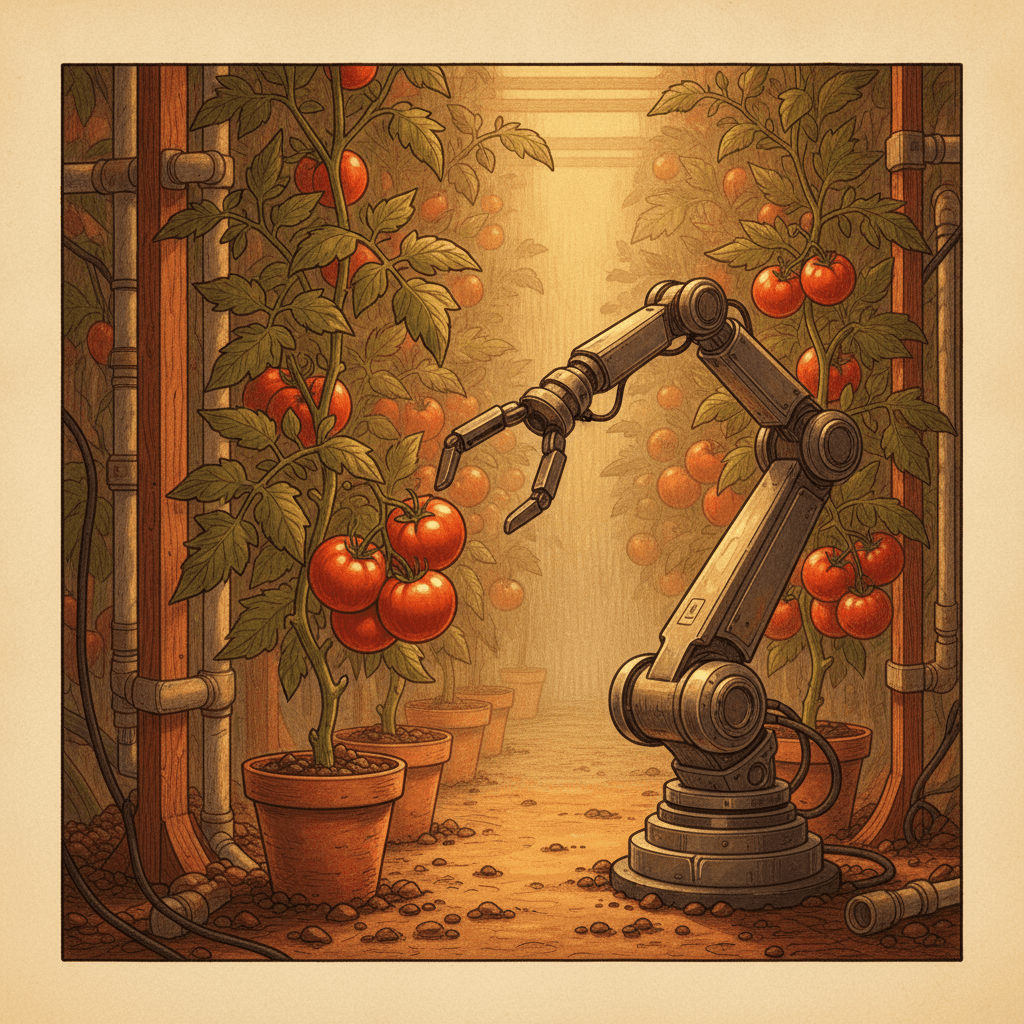
Robots Just Learned to Feel Your Farm's Soil
Imagine a robot hand that can tell if a plant needs water just by touching its stem. New science is giving machines a sense of touch sophisticated enough to feel subtle pressure and texture, opening doors for smarter farming and beyond.

Your future farm robots, the ones quietly tending to crops, may soon sense the world with incredible sensitivity, almost like your own fingertips. This isn't a distant dream; researchers have unveiled a new system that lets robots feel subtle pressures and textures, gathering information vital for delicate tasks like handling ripening fruit or planting seeds with just the right touch. This advancement could soon change how robots interact with complex, unpredictable environments, from factory floors to vast agricultural fields.
This isn't science fiction. Scientists at the Massachusetts Institute of Technology (MIT) and their collaborators have developed "OpenTac," a novel sensor and a complete system that allows for highly customizable and scalable tactile skins for robots. Their work, detailed in a preprint on arXiv, focuses on building an open ecosystem for touch-sensing technology that robots can easily adopt and learn from.
How Robots Are Finally Learning to Feel the World
The core of this tactile breakthrough lies in a special resistive sensor skin. Think of it like a thin, stretchy sheet with a structured, squishy overlay, similar to the tiny ridges on your fingerprints. When a robot arm touches something, this overlay deforms. If the robot presses straight down, the entire area feels the pressure. But if it slides or twists, like trying to pick up a delicate berry, the overlay shifts, creating different pressures in neighboring tiny sensing spots, which scientists call "taxels." This differential response across these tiny touch pixels allows the system to decode not just the force of the press, but also the direction of any sliding motion – what engineers call a shear vector. The overall squishiness, or "common-mode response," still tells you the normal force, like how hard you're pushing.
It’s a bit like when you run your finger across a textured surface, feeling both how hard you're pressing and the subtle bumps and grooves that create friction. The OpenTac system translates those physical feelings into electrical signals a robot can understand, giving it a much richer sense of contact than simple on-off pressure sensors. This means a robot could tell if it's holding a ripe tomato (soft, yielding) versus a firm potato (hard, resistant) without needing cameras or complex visual algorithms.

Designing a Sense of Touch for Any Robot
One surprising fact is how customizable these new tactile skins can be. The MIT team developed a design tool that automatically creates fabrication files for these touch sensors from simple 2D outlines or even abstract descriptions. Imagine just typing "design a sensor for a size 9 shoe insole" or "a soft grip for delicate flowers," and the software spits out the blueprints. This means engineers don't need to be touch-sensor experts; they can quickly tailor a sensor to fit a specific robot part, like a gripper for harvesting fragile produce or a footpad for a walking robot navigating uneven terrain. (/article/your-farm-robots-are-learning-on-the-job)
This flexibility is crucial because every robot arm, every gripper, and every environment has unique needs. The researchers demonstrated this by designing and building over 30 different sensors for various robot types, showing how broadly applicable the technology is. They even developed a simulator, a virtual sandbox where robot hands can "feel" things and practice tasks before any physical sensor is even made, speeding up development significantly.
Beyond the Farm: What This Means for Robotics
If robots can truly feel, their capabilities will expand dramatically. On farms, this could mean robots that can precisely assess a plant's ripeness, harvest fruit without bruising, or even detect changes in soil density during planting, leading to more efficient and less wasteful agriculture. It could allow for more nuanced handling of delicate seedlings or even the precise application of pesticides only where needed. (/article/your-farm-can-grow-more-with-less)
In other areas, imagine a robot surgeon that can feel the subtle resistance of tissue, guiding its movements with human-like precision, or a factory robot that can detect microscopic defects on a surface just by running its "finger" over it. This technology isn't just about making robots more capable; it's about making them more adaptive and intuitive in a world that is inherently tactile. While getting this technology into widespread use will take at least five to ten years for commercial rollout, the foundational work is clearly in place.
This advancement also ties into how robots learn. Just as a human baby learns about the world by touching everything, robots can use this new sense to gather more data and improve their understanding of physical interactions. The MIT team has shown that these sensors can acquire data at incredibly fast rates, allowing robots to react to unexpected slips or shifts almost instantaneously. This kind of rapid feedback is essential for complex manipulation tasks, making robots more reliable and safer to work alongside. (/article/your-body-sensors-are-getting-smarter)
The ability to feel is one of the most fundamental ways we interact with our environment. Giving this sophisticated sense to robots opens up a world where machines can truly understand the physical nuances of their tasks, moving them from simple tools to genuinely intelligent partners.
Key Takeaways
- Robots are gaining a sense of touch with "OpenTac" technology, allowing them to feel both direct pressure and subtle sliding motions.
- A new design tool lets engineers custom-build these tactile skins for specific robot needs, from delicate harvesting to industrial handling.
- This enhanced sense of touch promises to make robots more adaptive and precise, transforming industries like agriculture and advanced manufacturing.
Frequently Asked Questions
What is OpenTac? OpenTac is a new system combining highly sensitive robot skin sensors with design tools. It lets robots feel pressure and sliding forces, much like human touch, enabling them to better interact with objects and environments.
How does this robot "skin" work? It uses a soft, structured layer over resistive sensors. When touched, this layer deforms, creating unique electrical signals that tell the robot how hard it's pressing and if something is sliding, like a delicate fruit.
Why does a robot need a sense of touch? A sense of touch helps robots perform delicate tasks like handling fragile crops or assembling intricate parts. It provides crucial feedback beyond vision, allowing them to adapt to different textures and pressures in real-world settings.
When will this technology be widely used? While the core technology is proven, commercial rollout for widespread applications, especially in areas like agriculture, is likely 5-10 years away as it moves from labs to practical, large-scale deployment.
Editorial note: The scientific findings presented in this article are sourced exclusively from published research papers, peer-reviewed studies, certified inventions, and registered patent filings. Images generated by AI.
New guides and tools
Hands-on Claude guides, straight to your inbox
Step-by-step walkthroughs of what's new in Claude and Anthropic's tools, with real screenshots and honest results, including what didn't work. No hype, no jargon, no noise.
By subscribing, you agree to receive newsletter and marketing emails, and accept our Terms of Use and Privacy Policy. You can unsubscribe anytime.
Lin Xiaofeng
Food tech journalist tracing the future of how humanity will grow, manufacture, and eat its food.