AI Just Quietly Found Your Hidden Sickness
Your body constantly releases tiny packages of information that reveal your health, but they're incredibly hard to read. New AI tools are finally decoding these secret messages, promising earlier detection for serious diseases like cancer.

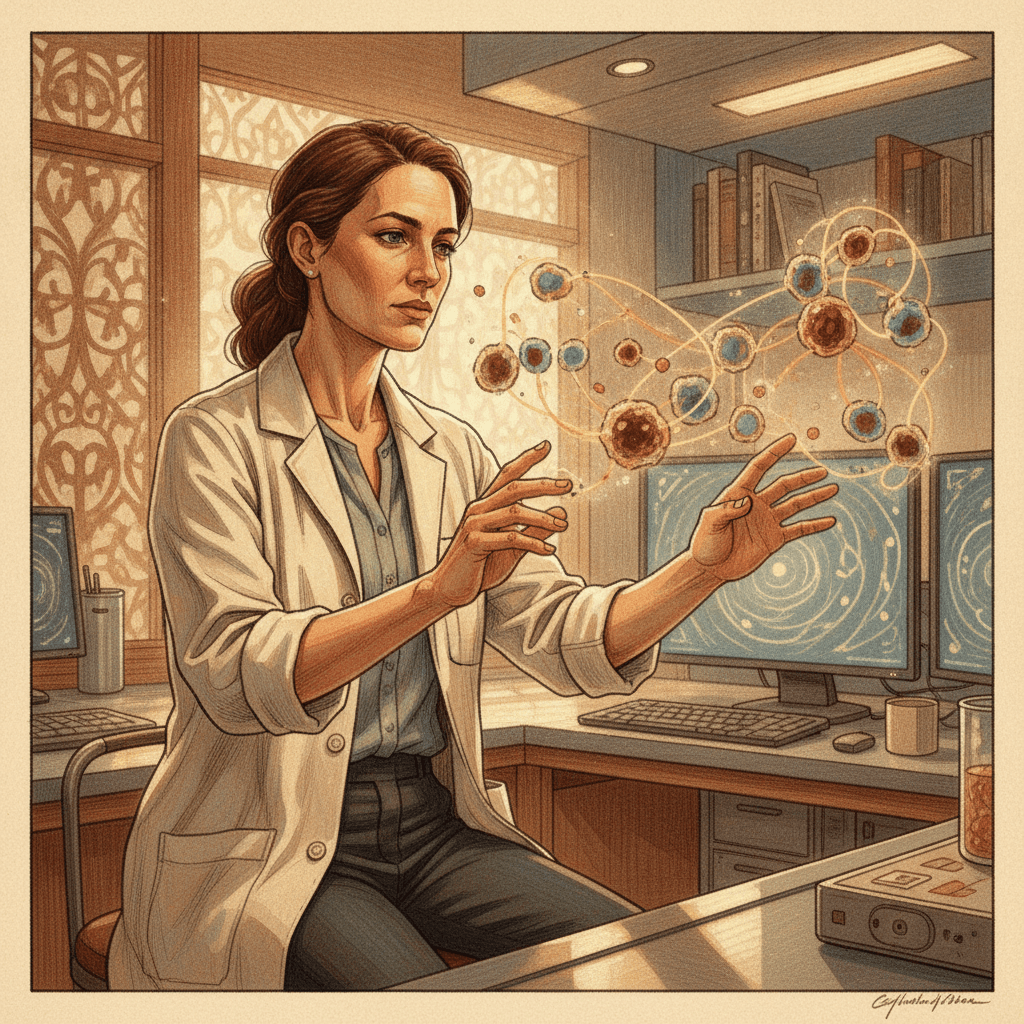
Your body is constantly sending out tiny, microscopic messages, like miniature sealed envelopes floating through your blood. These "extracellular vesicles" (EVs) carry snippets of genetic material and proteins from your cells, offering a peek into what's happening inside you. The problem is, these envelopes are incredibly small and mixed in with billions of others, making them almost impossible for us to sort through and read on our own.
That's where artificial intelligence (AI) comes in, acting like a super-powered postal worker that can instantly sort and read countless tiny letters. AI, especially advanced forms like machine learning and deep learning, is now being used to sift through these complex biological signals. It's helping scientists isolate, identify, and understand what these tiny messengers are saying, particularly when it comes to early signs of cancer. This means finding signs of illness long before symptoms appear, when treatments are most effective.
How AI Deciphers Your Body's Secret Signals
AI works by looking for patterns in data, much like how you might recognize a friend's face in a crowd. When applied to EVs, AI algorithms are trained on vast datasets of these tiny vesicles, learning to spot subtle differences that indicate health or disease. This process allows for much faster and more accurate analysis than traditional lab methods, which are often slow and manual.
For example, AI can analyze multimodal features – that's like looking at a letter's handwriting, paper type, and stamp all at once – to characterize the sheer variety of EVs. Researchers at institutions like the University of Southern California and the National Cancer Institute are already using AI to integrate complex data from patient samples. They are training AI models to differentiate between EVs from healthy cells and those from cancerous ones, boosting diagnostic accuracy.

Moving From Lab Curiosity to Real-World Tools
The application of AI to EV diagnostics is surprisingly close to becoming a part of routine medical care. Unlike other AI health projects that are still deep in theoretical stages, several studies have already shown promising results with real patient samples. This means we're seeing AI-powered platforms that can take a patient's blood or other body fluid, analyze the EVs, and identify markers for disease with impressive precision.
One surprising fact is how quickly AI can learn to spot incredibly subtle biological fingerprints that human experts might miss. Imagine looking at a hundred different identical-looking grains of sand, but one has a microscopic scratch that only a supercomputer could see. This is the level of detail AI can achieve when analyzing these complex biological molecules, potentially offering a secret shield against hidden sickness that we've never had before. This ability makes AI a powerful ally in the fight against diseases where early detection is key.
What AI Is Learning to Find
Beyond just detecting cancer, AI is also being trained to understand the "heterogeneity" of EVs. This means recognizing that not all EVs are the same, even from the same cell type, and that these differences can carry important information. It's like learning not just that a letter is from a specific friend, but also noticing the subtle variations in their handwriting that tell you if they're happy or stressed.
This advanced analysis helps in diagnostic classification, helping doctors understand not just if you have a disease, but what kind and how aggressive it might be. Furthermore, AI is being integrated with advanced isolation techniques, like microfluidic devices (tiny lab-on-a-chip systems), and imaging methods such as surface-enhanced Raman spectroscopy (SERS) and fluorescence imaging. These combinations create incredibly sensitive systems for capturing and analyzing these tiny biological clues. How AI is finally learning your body's secret signals is truly remarkable, allowing for a deeper understanding of human health.
The Path Ahead: From Diagnostics to Treatments
While AI-assisted EV diagnostics are showing rapid progress, the use of AI to design EV-based therapies is still largely exploratory. Think of it this way: AI is really good at reading the mail, but it's still learning how to write custom messages that can deliver medicine precisely where it's needed. However, as more diverse EV datasets become available from multiple research centers, and as AI algorithms become even more robust, we can expect significant advances.
The goal is to move towards a future where AI not only helps us diagnose diseases earlier but also helps us engineer these tiny vesicles into smart drug delivery systems. This would mean precise, targeted treatments with fewer side effects, potentially by 2035 if research continues its current pace and funding grows. It could fundamentally change how you experience healthcare, making diagnoses faster, less invasive, and much more accurate, truly sensing your body's hidden sickness you can't see.
Key Takeaways
- AI is decoding tiny cellular messages (extracellular vesicles) to detect diseases like cancer earlier.
- These AI-powered diagnostic tools are already in advanced testing with patient samples, making them surprisingly close to clinical use.
- Beyond diagnosis, AI is being explored to design smart, targeted drug delivery systems using these same cellular messengers.
Frequently Asked Questions
What are extracellular vesicles (EVs)? Extracellular vesicles are tiny sacs released by cells that carry proteins and genetic material, acting as messengers between cells. They provide a snapshot of cellular health and disease, circulating throughout your body.
How does AI help analyze EVs for health insights? AI processes vast amounts of EV data, identifying subtle patterns and characteristics that indicate disease, such as cancer. It sorts and classifies these tiny particles much faster and more accurately than manual methods.
When might AI-powered EV diagnostics be available? AI-assisted EV diagnostic tools are already showing promise in clinical studies using patient samples. Some applications could be integrated into healthcare settings within the next 5-10 years, offering earlier disease detection.
Editorial note: The scientific findings presented in this article are sourced exclusively from published research papers, peer-reviewed studies, certified inventions, and registered patent filings. Images generated by AI.
Stay ahead of the curve
The science that shapes tomorrow — in your inbox every week
The scientific findings presented in our articles are sourced from published research papers, peer-reviewed studies, certified inventions, and registered patent filings. Subscribe for focused weekly coverage, hands-on explainers, and practical insights that help you stay curious — no jargon, no noise.
By subscribing, you agree to receive newsletter and marketing emails, and accept our Terms of Use and Privacy Policy. You can unsubscribe anytime.
AI in Healthcare, Biomedical Computing & Drug Discovery Algorithms
Computational biologist and science journalist covering the remarkable collision of artificial intelligence with medical research.
View full profile →