How AI Is Quietly Learning Your Unique Heart
Imagine your doctors seeing a perfect, digital copy of your heart. New AI isn't just modeling hearts; it's learning to personalize those models to you, getting smarter with every new patient. This could radically change how we predict and treat heart conditions.
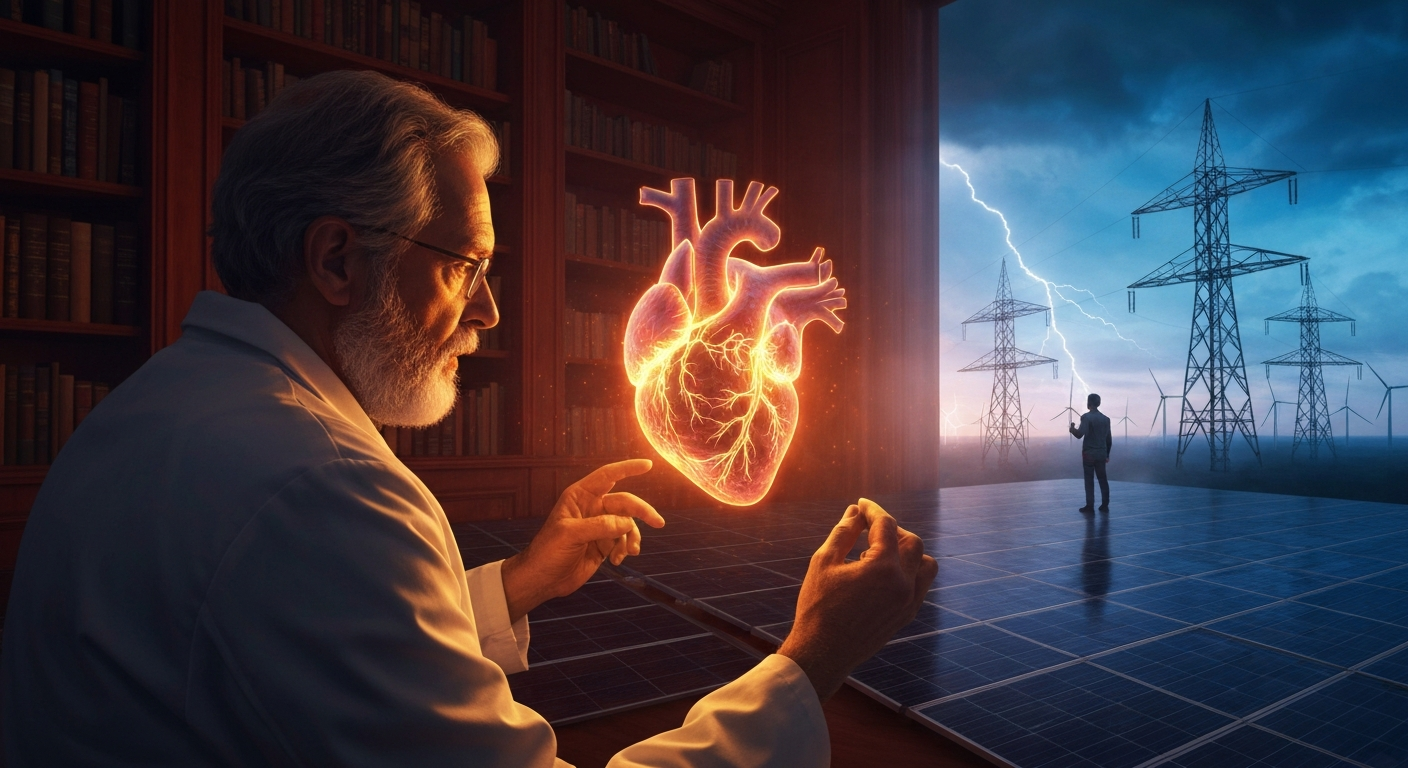
What if your doctor could look inside a perfect, digital twin of your heart, running simulations to predict future problems or test treatments, all tailored exactly to you? This isn't science fiction anymore. While creating such a detailed model has always been too slow and complex for real-time patient care, a new approach powered by AI is making this vision not just possible, but incredibly personal.
For years, doctors have used advanced computer models to understand the heart’s electrical activity. These "simulations" are like highly detailed virtual experiments, mimicking how your heart beats. The problem? They’re incredibly complex, requiring supercomputers and often taking hours, even days, to run for just one patient – making them impractical for fast-paced medical decisions.
Teaching AI to Learn Your Heart's Deepest Secrets
The real challenge begins when we try to make these simulations unique to you. Think of it like a tailor trying to craft a perfectly fitting suit without ever taking your measurements. Every heart has subtle differences in its shape, size, and electrical pathways. Traditionally, updating these models with new patient information meant restarting from scratch, which is hugely time-consuming and inefficient.
This is where a fresh perspective in AI comes in, currently being explored by researchers. Instead of creating one giant, rigid heart model, they're teaching artificial intelligence systems to build incredibly fast, intelligent stand-ins, called "neural surrogates." Imagine having a brilliant intern who can instantly provide the same precise answers as a senior cardiac specialist, but at lightning speed. These surrogates are designed to mimic the complex, slow computer simulations, but deliver results almost instantly.
Why Your Heart Needs Its Own Digital Tailor
The real magic happens when this AI learns how to learn about your specific heart. This process is called "meta-learning." It's like teaching the tailor not just to cut fabric, but to understand the fundamental principles of custom fitting, allowing them to adapt quickly to anyone new. This means with just a small amount of new data – perhaps from an MRI or an EKG – the AI can rapidly personalize an existing heart model to match your unique physiology.
A truly surprising fact about your heart is that even tiny, millimeter-scale variations in its tissue can significantly alter how electrical signals travel, impacting everything from a skipped beat to a life-threatening arrhythmia. Traditional simulations struggle to account for this personal detail efficiently, highlighting why personalized AI is so important for predicting conditions like heart failure or irregular rhythms.
Giving AI a Long-Term Memory for Patient Care
A common problem for many AI systems is "catastrophic forgetting." This happens when an AI learns something new, like data from a new patient, and completely forgets what it knew about previous patients. It’s like a doctor getting amnesia with every new case. This is a huge barrier in clinical settings where patient data arrives continuously and unpredictably. We can’t just re-train the entire AI system every time new information comes in – that would be slow and expensive.
The new framework, called CoMetaPNS (Continually Meta-learning Personalized Neural Surrogates), directly tackles this by giving the AI a sort of long-term memory. It uses a clever "memory buffer" combined with a "continual Bayesian Gaussian Mixture Model." Think of this as an incredibly smart librarian who doesn't just add new books to the shelf, but also immediately recognizes if a new book is similar to one already there, or if it's from a completely new author or genre. This helps the AI understand if incoming heart data represents a known pattern or something entirely novel, allowing it to integrate new information without losing old lessons.
What This Means for Your Future Health
This ability to continually learn and personalize without forgetting old knowledge is a big step forward. Researchers at the Karlsruhe Institute of Technology, among others, are actively developing these kinds of frameworks. They are demonstrating that these models can forecast heart activity more accurately, work much faster, and remember previous data far better than older methods. This technology could allow doctors to create a personal heart simulation for you that updates as your health changes, offering insights into treatment options or potential risks.
For instance, if you're managing a chronic heart condition, this AI could help your cardiologist refine your medication or treatment plan by quickly testing different scenarios on your digital heart, rather than waiting for you to experience symptoms. It’s like having a crystal ball for your cardiovascular health, providing highly specific predictions. Such an approach might even help predict your future memory challenges, as your blood sugar is quietly stealing memory and other systemic factors influence overall health.
This kind of personalized cardiac care is still some years away from widespread clinical use, likely 5-10 years, as it requires extensive clinical trials and regulatory approvals. However, the foundational pieces are being laid right now. Expect to see these AI systems begin assisting doctors in more specialized diagnostic and planning tasks first. Just as your dentist's computer sees things you miss, these AI-powered heart models will offer a deeper, more personal view of your health than ever before.
In the future, imagine your annual check-up including an instant, personalized simulation of your heart. This isn't just about faster diagnoses; it's about shifting medicine from reactive treatment to proactive, personalized care, keeping your unique heart beating stronger for longer.
Key Takeaways
- New AI models, called neural surrogates, are dramatically speeding up complex heart simulations, making personalized cardiac care a real possibility.
- This AI uses "meta-learning" to quickly adapt existing heart models to your unique biology, potentially predicting individual risks and optimizing treatments.
- A key innovation allows the AI to continually learn from new patient data without forgetting past knowledge, moving personalized medicine closer to everyday clinical practice.
Frequently Asked Questions
What is a neural surrogate for the heart? It's an artificial intelligence model that acts as a super-fast, intelligent stand-in for complex, slow computer simulations of your heart's electrical activity. It provides quick, accurate predictions of heart behavior.
How does AI personalize heart simulations? Using a method called meta-learning, the AI learns how to learn about your unique heart. With just a small amount of new patient data, it can quickly adapt an existing heart model to your specific physiology.
Why is "catastrophic forgetting" a problem for medical AI? Catastrophic forgetting means an AI forgets previous patient data when learning new information. The new CoMetaPNS framework solves this, allowing the AI to continually learn from new patients without losing its accumulated knowledge.
Editorial note: The scientific findings presented in this article are sourced exclusively from published research papers, peer-reviewed studies, certified inventions, and registered patent filings. Images generated by AI.
Stay ahead of the curve
The science that shapes tomorrow — in your inbox every week
The scientific findings presented in our articles are sourced from published research papers, peer-reviewed studies, certified inventions, and registered patent filings. Subscribe for focused weekly coverage, hands-on explainers, and practical insights that help you stay curious — no jargon, no noise.
By subscribing, you agree to receive newsletter and marketing emails, and accept our Terms of Use and Privacy Policy. You can unsubscribe anytime.
Offshore Wind, Ocean Energy & Nordic Green
Nordic climate journalist covering the energy innovations emerging from the world's most ambitious green economies.
View full profile →