Finally, Solar Cells That Work, And Last
Imagine solar panels on your roof that truly deliver consistent power for years without losing their edge. A surprising new method strengthens the internal connections, boosting solar efficiency and making them incredibly durable.
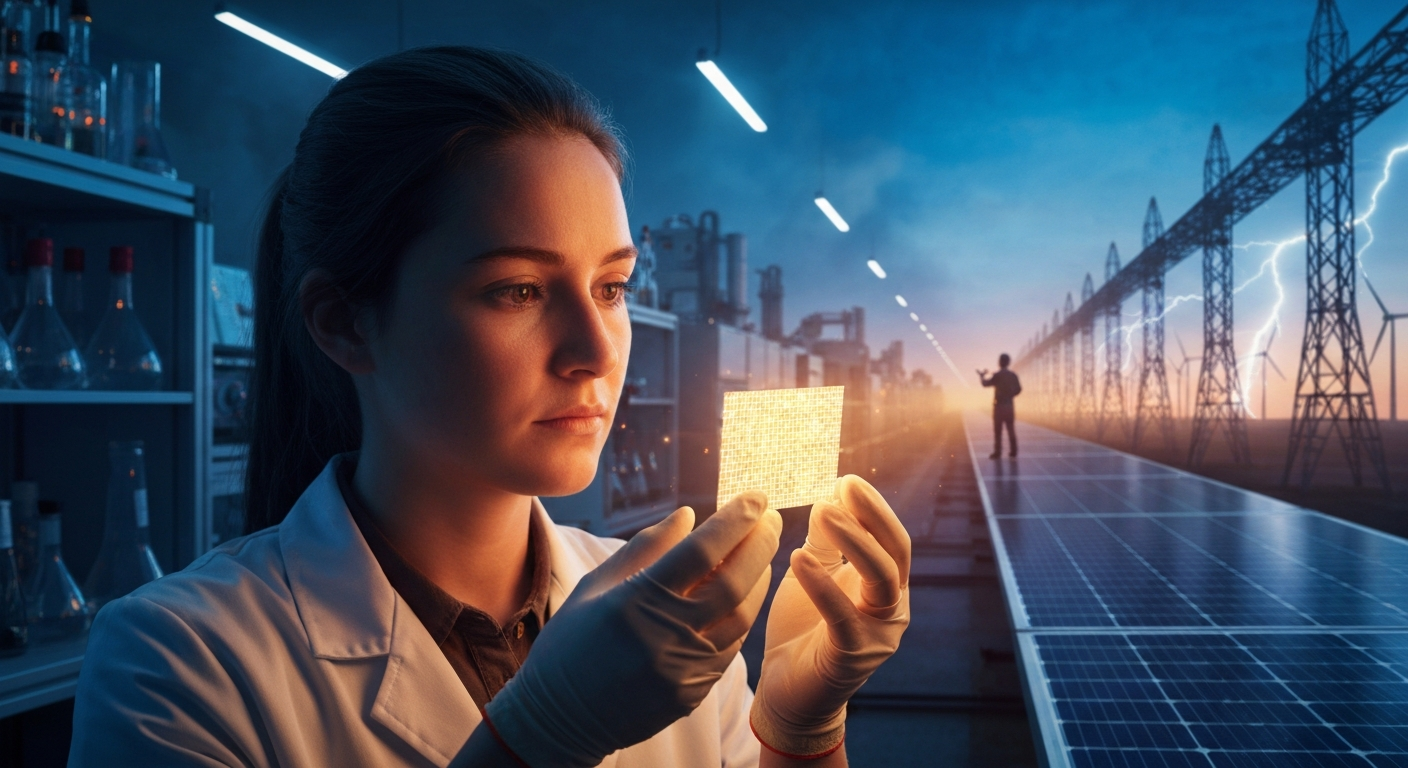
You know the promise of solar power. Clean energy, lower electricity bills, a step towards a greener future. It all sounds amazing on paper, but if you’ve looked into it, you might have heard the whispers: solar panels, especially the newer, more efficient types, can sometimes have a hidden Achilles' heel. They might not last as long as you'd hope, or their performance can slowly fade over time.
This isn't because the core technology is flawed, but often due to tiny, invisible weaknesses at the most crucial points inside the panel. Think of it like a beautiful brick wall where the mortar isn’t quite strong enough in places; over time, those weak spots are where problems begin. For a newer, promising type of solar cell called a perovskite cell, this has been the major hurdle preventing them from truly taking over the market.
Solving the Invisible Weak Spots in Solar Cells
These perovskite solar cells are incredibly efficient at turning sunlight into electricity, often outperforming traditional silicon panels in lab settings. But their Achilles' heel? Stability. They can be sensitive to moisture, heat, or even just the daily grind of producing electricity, which causes their efficiency to drop faster than you’d like. The problem often lies in the "buried interfaces," which are essentially the microscopic connection points where different layers of the solar cell meet and transfer energy. If these connections are weak or have tiny flaws, the whole system suffers.
Now, a team of materials scientists has found a remarkably clever way to fix these hidden flaws using what they call a "π‐ionic lock interlayer." Imagine trying to build a perfectly stable house using only interlocking LEGO bricks. This new interlayer acts like a special, ultra-strong super-glue or rebar, meticulously strengthening the mortar between those bricks, but at a molecular level. It's designed to lock everything together much more tightly and robustly.
How a Molecular "Lock" Makes Power Flow Better
This "π‐ionic lock" works its magic in two key ways, reinforcing the internal structure of the solar cell. First, it creates stronger "interfacial electronic coupling" – think of it like making sure every single electrical connection inside the cell gets a perfect, firm handshake, allowing electricity to flow smoothly and without resistance. Instead of a loose wire, you get a solid, unbreakable bond.
Second, it "passivates defects," which means it fills in any tiny atomic gaps or imperfections that naturally occur at these connection points. These defects are like tiny potholes on a highway for electrons, causing them to get stuck and lose energy. By patching these potholes, the "π‐ionic lock" ensures a super-smooth, uninterrupted path for electrons, meaning more of the sun’s energy actually gets converted into usable power for your home. This clever approach creates a much more stable and efficient surface for the perovskite material to form on, like laying a perfect foundation for a building.
Reaching Unheard-Of Efficiency and Stability
The results of this microscopic reinforcement are genuinely surprising. Solar cells equipped with this new "π‐ionic lock" interlayer achieved a certified power conversion efficiency of 26.64%. To put that into perspective, most commercial silicon solar panels average around 17-20% efficiency, with high-end models hitting 22-23%. This is a significant leap, pushing perovskite technology far ahead.
Even more importantly for the longevity problem, these strengthened cells maintained over 90% of their initial efficiency after more than 2,200 hours (that’s almost three months) of continuous storage in controlled, low-humidity conditions. This stability is a huge win for perovskite cells, which have historically struggled to maintain performance over extended periods. It suggests that the future of reliable, high-performing solar energy could be much closer than you think. You can imagine how much more impact your home's power generation could have if it lasted much longer.
What This Means for Your Future Power Bill
While this incredible technology is still in the research and development phase, it’s not something you’ll see on your roof next week. Scientists still need to scale up production and perform extensive real-world testing under diverse environmental conditions – from scorching deserts to freezing winters – to ensure it holds up. We're likely talking about five to ten years before this type of technology is widely available in commercial products.
However, this breakthrough is a clear signal of what’s coming. Imagine a world where solar panels on your home are not only significantly more efficient but also incredibly durable, quietly generating power for decades without major drops in performance. This could mean even lower long-term energy costs for you, a reduced carbon footprint, and a more robust, decentralized energy grid for everyone. It shows that sometimes, the biggest problems are solved by focusing on the smallest, most hidden details.
Key Takeaways
- A new "π‐ionic lock interlayer" significantly boosts perovskite solar cell efficiency to over 26% and improves stability by 90% over extended periods.
- This technology works by strengthening molecular connections and fixing microscopic flaws ("defects") within the solar cell, allowing electricity to flow more efficiently.
- While not yet commercial, this research paves the way for future solar panels that are both more powerful and durable, potentially lowering energy costs and accelerating clean energy adoption within 5-10 years.
Frequently Asked Questions
What are perovskite solar cells? Perovskite solar cells are a newer type of solar technology that uses a unique crystalline material to capture sunlight and convert it into electricity with very high efficiency, offering a promising alternative to traditional silicon panels.
What is the "π‐ionic lock interlayer"? It's a special molecular layer added between the key components of a perovskite solar cell. It acts like an advanced glue and structural support, strengthening connections and fixing tiny flaws to improve overall performance and durability.
How does this improve solar cell performance? This interlayer improves performance by making electron flow smoother and preventing energy loss. It strengthens electrical connections and patches microscopic defects, leading to higher efficiency and better stability over time.
When will this technology be available for homes? While highly promising, this technology is still in research and development. It needs further testing and scaling for mass production, so it's likely five to ten years away from being widely available for home use.
Editorial note: The scientific findings presented in this article are sourced exclusively from published research papers, peer-reviewed studies, certified inventions, and registered patent filings. Images generated by AI.
Stay ahead of the curve
The science that shapes tomorrow — in your inbox every week
The scientific findings presented in our articles are sourced from published research papers, peer-reviewed studies, certified inventions, and registered patent filings. Subscribe for focused weekly coverage, hands-on explainers, and practical insights that help you stay curious — no jargon, no noise.
By subscribing, you agree to receive newsletter and marketing emails, and accept our Terms of Use and Privacy Policy. You can unsubscribe anytime.
Solar Innovation, Batteries & Grid Technology
Energy journalist covering the technologies quietly replacing fossil fuels — faster than most people realise.
View full profile →